

Samaki Poa trains 2,700 aquaculture entrepreneurs across East Africa
Beyond training, the hubs also gave fish farmers access to quality fingerlings and direct connections to public and private sector aquaculture stakeholders.
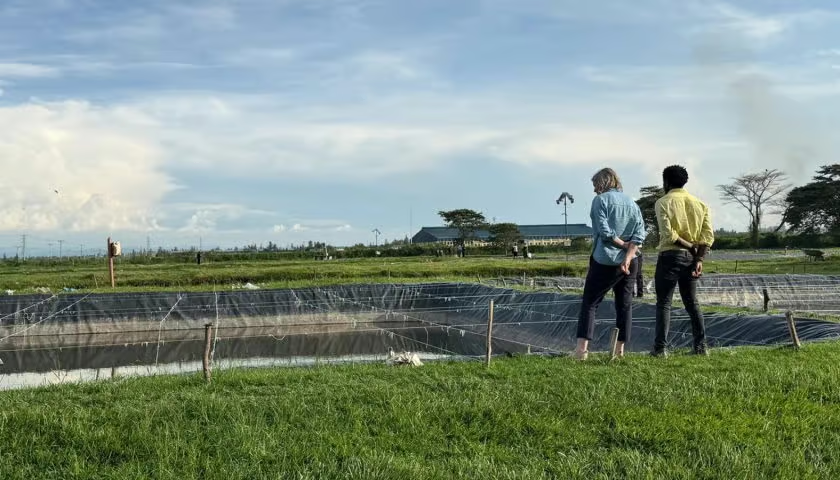
EAST AFRICA – A EUR 2 million (USD 2.3 million) Norwegian-funded aquaculture project has trained around 2,700 entrepreneurs through five training and distribution hubs in Kenya, Uganda and Rwanda, supporting sustainable fish production, business development and food security across the region.
The Samaki Poa project, launched in 2022 and concluded in June, established two hubs in Kenya and Uganda and one in Rwanda.
The facilities provided practical and digital training covering different stages of the aquaculture value chain, while also improving farmers’ access to quality fish fingerlings and connections with public- and private-sector stakeholders.
The Norwegian Agency for Development Cooperation (Norad) financed the project, with Dutch consulting firm Larive International serving as project manager.

Lattice Consulting led the training component, while animal nutrition companies Tunga Nutrition and Skretting supported the initiative by providing quality fish feed.
According to Claudy Luft, emerging markets advisor at Larive International, the project helped expand access to practical aquaculture knowledge and technology, particularly among women, young people and other emerging fish-farming entrepreneurs.
She said the project’s training materials, including videos and graphics, have also attracted interest outside East Africa, with users signing up from countries including Ghana, Egypt, South Africa and Zambia.
Building stronger aquaculture businesses

Beyond production techniques, Samaki Poa emphasised improving fish farmers’ business capabilities.
Lattice Consulting Technical Project Manager John Erick said training in areas such as recordkeeping and financial management helped farmers adopt practices that could make their enterprises more attractive to conventional lenders.
“Aquaculture is viewed as a risky sector by lending institutions such as banks,” Erick said, adding that stronger business practices could help reduce perceived risks and improve farmers’ access to credit.
Although the project did not provide direct financing to fish farmers, Erick said its approach focused on creating an ecosystem connecting actors across the aquaculture value chain.
The hubs therefore served not only as training centres but also as points where entrepreneurs could access production inputs and connect with other stakeholders in the sector.
By the end of the project, more than 13,000 individuals from over 35 African countries had accessed the Samaki Poa digital learning platform, extending the initiative’s reach beyond its physical hubs.
The project’s focus on training, inputs and value-chain linkages reflects the growing need for stronger support systems as African aquaculture expands to meet rising demand for fish and improve food security.
For East Africa, where small and emerging producers remain important to domestic fish supply, improving access to quality fingerlings, feed, technical knowledge and financial services could help farmers move towards more commercially sustainable production.
The completion of Samaki Poa leaves behind a network of trained entrepreneurs, physical hubs and digital learning resources that could continue supporting aquaculture development beyond the project’s initial three-country footprint.
Sign up HERE to receive our email newsletters with the latest news updates and insights from Africa and the World, and follow us on our WhatsApp channel for updates.
Be the first to leave a comment