

Turkish group plans 22,000-hectare livestock feed project in Algeria to cut import reliance
The project aims to boost local forage production and cut feed imports
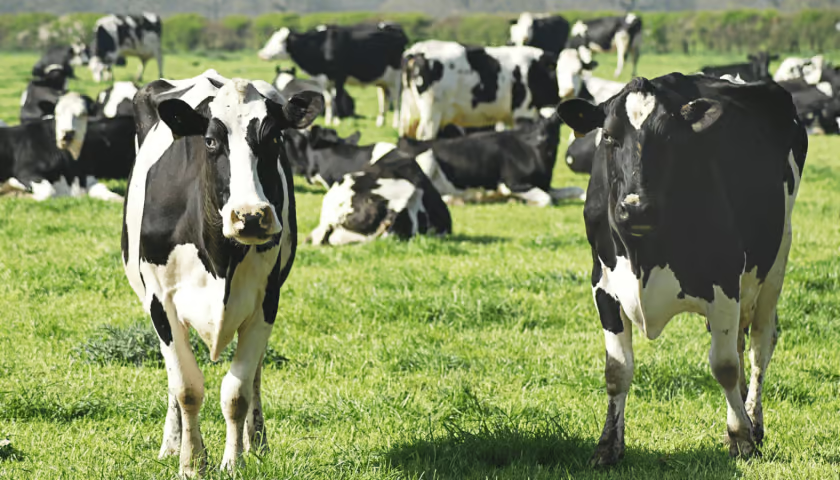
ALGERIA – Turkish industrial group SPA Özmert Algeria is planning a large-scale livestock feed and forage production project covering 22,000 hectares in Algeria’s Naâma province, aimed at strengthening domestic feed supply and reducing reliance on imports.
According to a statement published on May 22 on the provincial government’s website, the project is currently under review within Algeria’s strategic agricultural investment framework.
No investment value or construction timeline has been disclosed.
The development is positioned as a key agro-industrial initiative to ensure livestock feed security in a country where dependence on imported cereals remains significant.
Authorities and project planners say the scheme will focus on large-scale forage production, including barley, triticale, sorghum and silage maize, all adapted to Naâma’s semi-arid climate.
The aim is to support Algeria’s cattle and dairy industries while improving local feed availability.
A key feature of the project is the planned use of modern irrigation infrastructure.
Reports indicate that around 80 centre-pivot irrigation systems will be deployed, each linked to boreholes, as part of an effort to optimise water-use efficiency in the arid region.
The project also includes investment in storage and logistics infrastructure such as grain silos and strategic reserves, designed to stabilise supply during drought periods and seasonal shortages.
Developers expect the initiative to generate more than 500 direct and indirect jobs while also stimulating growth in agricultural mechanisation and maintenance services.
Algeria remains heavily dependent on imported feed inputs, particularly barley, a key component of livestock rations.
According to the U.S. Department of Agriculture (USDA), nearly 40% of the country’s barley demand is met through imports annually.
Reducing import dependence in a constrained feed market
Barley plays a central role in Algeria’s livestock sector, with more than 80% of consumption directed toward ruminant feed, including sheep, cattle and camels.
This underscores its strategic importance in maintaining domestic animal protein production.
Trade Map data show that Algeria imported an average of 573,337 metric tons of barley annually between 2021 and 2025, with imports peaking at 867,579 metric tons in 2024.
Over the same period, the country’s annual barley import bill averaged US$134.2 million.
If implemented, the Naâma project could help shift part of this demand toward local production, strengthening domestic forage supply chains and reducing exposure to global price volatility in feed markets.
The initiative also reflects a broader regional trend in North Africa and the Middle East, where governments and private investors are increasingly prioritising large-scale agricultural projects to improve feed security and bolster resilience in the livestock sector amid climate and supply chain pressures.
Sign up HERE to receive our email newsletters with the latest news updates and insights from Africa and the World, and follow us on our WhatsApp channel for updates.


Be the first to leave a comment