

Burkina Faso expands cage farming as fish feed costs challenge aquaculture growth
The Yacouta project was stocked about six months before the first harvest and is part of a broader government strategy to increase domestic fish production.
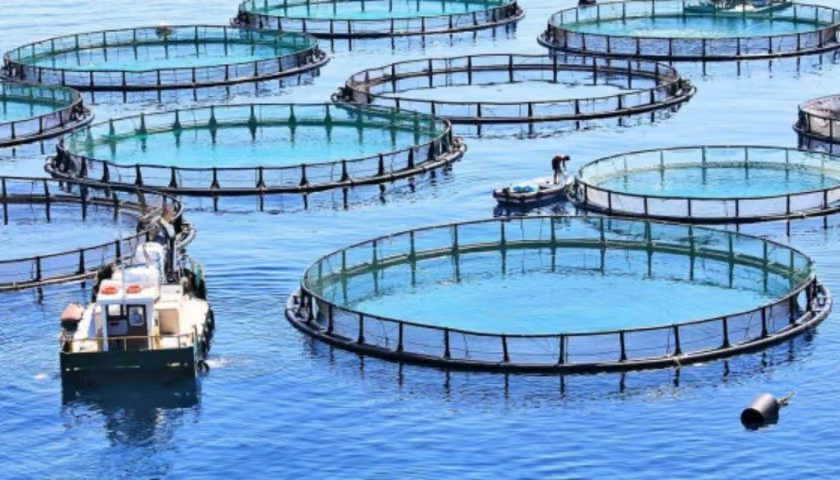
BURKINA FASO – Burkina Faso has begun harvesting fish from 18 floating cages at the Yacouta dam in Dori, with the first harvest expected to produce about 15 tonnes as the country expands aquaculture to reduce reliance on imported fish and strengthen domestic production.
The cages were stocked about six months before the first harvest, launched on 24 August 2026, marking another step in the government’s push to develop cage farming across the country’s reservoirs.
The initiative comes as Burkina Faso faces a significant gap between domestic fish production and consumption.
Food and Agriculture Organization data cited by Ecofin show that the country produced 31,406 tonnes of fish in 2023, including only 1,127 tonnes from aquaculture, while apparent consumption reached 241,441 tonnes.
Burkina Faso consequently relies heavily on imports.
National statistics show that the country imported an average of 165,141 tonnes of fishery products annually between 2020 and 2024, at an average cost of CFA19.3 billion (US$34.7 million) per year.
The government estimates the country’s theoretical aquaculture production potential at about 110,000 tonnes annually, creating significant scope for expansion.
Feed remains a major aquaculture constraint

Yacouta is part of a wider push to use floating cages to increase domestic fish production without requiring additional land for pond construction.
Similar initiatives are underway at the Samandéni and Bagré reservoirs.
Samandéni had 180 floating cages installed after cage production was launched in 2024, while more than 500 cages are reportedly at different stages of implementation at Bagré.
However, scaling production will depend heavily on the availability and cost of key aquaculture inputs, particularly fish feed.
Feed accounts for about 80% of aquaculture production costs in Africa, according to figures cited in reporting on Burkina Faso’s sector.
Supply constraints can also leave African producers paying prices 10% to 20% above global averages.
Burkina Faso has introduced measures to address the feed-cost challenge.
The country introduced a VAT exemption on fish feed under its 2025 supplementary budget to reduce production costs and encourage investment in aquaculture.
The government has also been working to strengthen domestic fish-feed production, alongside hatchery rehabilitation and increased fingerling production.
These measures are important as Burkina Faso targets much larger aquaculture volumes.
Fisheries authorities have set an ambition of producing 100,000 tonnes of fish from floating cages during the 2026-2028 period.
Building a commercial aquaculture value chain
Burkina Faso is pursuing cage farming as part of broader efforts to increase domestic food production and reduce dependence on external supplies.
Beyond fish production itself, expansion could create demand for feed manufacturing, hatcheries, cage equipment, transport, cold storage and fish processing.
For the sector to reach its production potential, however, farmers will need reliable access to quality fingerlings and affordable feed, along with technical expertise, financing, and markets.
The 15-tonne harvest from Yacouta is therefore an early test of cage farming’s commercial viability.
Sustained production and successful replication across other reservoirs will be critical if Burkina Faso is to close its large fish supply gap and establish aquaculture as a significant contributor to domestic food security.
Sign up HERE to receive our email newsletters with the latest news updates and insights from Africa and the World, and follow us on our WhatsApp channel for updates.
Be the first to leave a comment