
Uganda’s NAGRC targets stronger livestock genetics and feed access
The initial focus will be on dairy cattle, piggery and poultry enterprises.
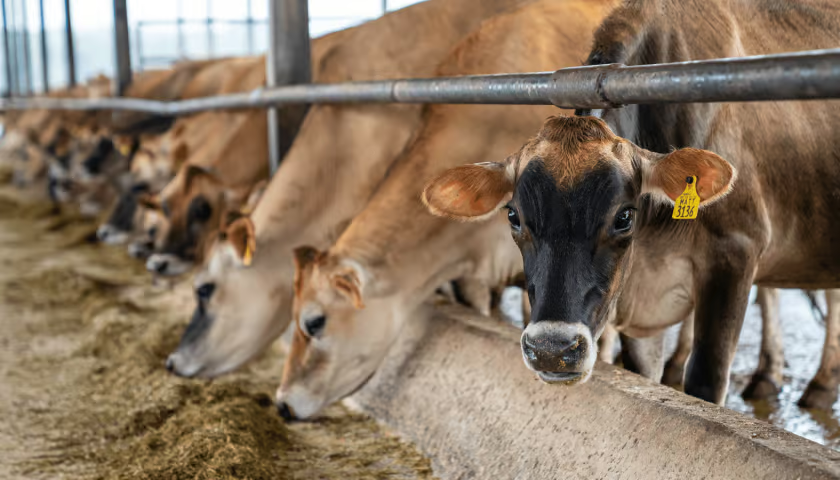
UGANDA – Uganda’s National Animal Genetic Resources Centre and Data Bank (NAGRC&DB) is rolling out a new institutional framework to improve livestock genetics, breeding, feed access, and farmer services as the country seeks to transform smallholder production into a more commercial and competitive sector.
The semi-autonomous agency, operating under the Ministry of Agriculture, Animal Industry and Fisheries (MAAIF), recently unveiled five institutional instruments at its headquarters in Entebbe.
The instruments are designed to translate national livestock policies into practical interventions for farmers, with the Minister of State for Animal Industry, Dr Bright Rwamirama, stressing that their success will depend on grassroots implementation.
“Their true worth depends entirely on how effectively these commitments are integrated into routine extension work, breeding operations, and farm-gate service delivery to drive livestock productivity across Uganda,” Rwamirama said.
Among the measures is NAGRC&DB’s Communication and Knowledge Management Strategy (2026/27 to 2029/30), which is intended to improve the flow of technical knowledge from research institutions and laboratories to farmers.
The strategy assigns responsibilities for generating, validating and preserving agricultural knowledge while improving farmers’ access to information on livestock breeds, feeds and management practices.
Breeding and feed at the centre of livestock transformation
A central component of the new framework is the National Animal Breeding Strategy and Action Plan (NABSAP), which provides guidelines for developing, characterising, inventorying, monitoring, and conserving Uganda’s animal genetic resources.
Rwamirama said the strategy will help farmers gain wider access to high-yielding, market-oriented and climate-resilient genetics while protecting Uganda’s indigenous livestock diversity.
“At the centre of this strategy is the National Animal Breeding Strategy and Action Plan (NABSAP),” he said.
The national approach is also being translated into a five-year NAGRC&DB Strategic and Investment Plan covering FY2025/26 to FY2029/30.
Under the plan, the agency will accelerate breeding and multiplication of farmer-preferred breeds across dairy cattle, beef cattle, goats, pigs, poultry and fish.
Importantly for livestock productivity, the plan also prioritises the production of quality and affordable animal feeds, alongside conservation of native genetic stock and stronger institutional capacity for field-level service delivery.
NAGRC&DB’s breeding objectives are also linked to Uganda’s broader agro-industrialisation ambitions, including expanding value-added animal products such as milk powder and supporting the livestock sector under the Agro-industrialisation Programme of the Fourth National Development Plan.
Taking improved genetics closer to farmers
The agency is also using Uganda’s Parish Development Model (PDM) to address one of the major barriers facing smallholder producers: the cost and distance involved in accessing superior breeding stock.
Under its Strategic and Investment Plan, NAGRC&DB will support PDM enterprise groups by making high-performing livestock genetics available at subsidised prices.
The initial focus will be on dairy cattle, piggery and poultry enterprises.
Rwamirama said NAGRC&DB’s network of centres will serve as breeding, multiplication and technology-transfer hubs, helping move improved genetics and technical knowledge closer to rural communities.
The broader objective is to create a more connected livestock system in which breeding, nutrition, knowledge transfer and farm services work together to raise productivity and strengthen the commercial potential of Uganda’s livestock farmers.
Sign up HERE to receive our email newsletters with the latest news updates and insights from Africa and the World, and follow us on our WhatsApp channel for updates.



Be the first to leave a comment