

Scottish Sea Farms expands AI-powered feeding technology
Following positive Orkney results, Scottish Sea Farms is expanding its collaboration with Tidal and BioMar to more sites.
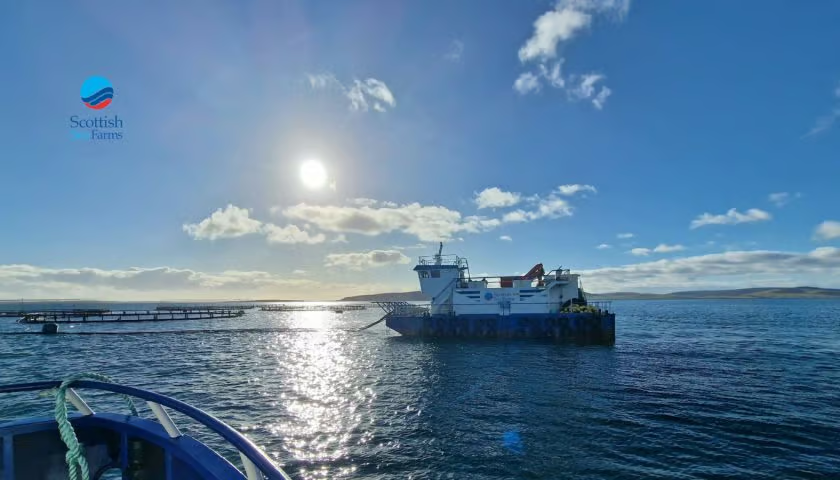
UK – Scottish Sea Farms (SSF) is expanding its use of Tidal’s autonomous feeding technology to additional salmon farming sites across mainland Scotland, Orkney and Shetland following positive early results from an ongoing project in Orkney.
The collaboration brings together SSF’s aquaculture expertise, BioMar’s nutritional knowledge and Tidal’s AI-powered feeding technology.
At the Orkney site, Tidal’s system continuously monitors fish behaviour and environmental conditions during feeding.
It then adjusts feeding rates in real time based on the fish’s appetite and response.

SSF said early results have tracked in line with its expected performance model, increasing confidence in the technology’s feeding decisions.
“The early experience has been very positive. The results are tracking in line with the expected performance model, which gives us increased confidence in the feeding decisions,” said Duane Coetzer, regional production manager at SSF.
“By bringing together farming, nutrition and technology, we can develop a much more precise understanding of what is happening during feeding.”
The expanded deployment will allow the partners to test the technology across different farming environments and gather additional data under commercial production conditions.

AI targets feed efficiency in salmon farming
The expansion reflects growing interest in data-driven feeding systems within aquaculture, where feed represents a high operating cost and efficient feed utilisation is closely linked to fish growth, health and environmental performance.
Mikey Clarkson, commercial manager at BioMar UK, said combining nutrition, fish behaviour and real-time data could support more targeted feeding strategies.
“When we connect nutrition, fish behaviour and real-time data, we can develop more targeted feeding strategies that support fish performance while also contributing to more efficient use of feed,” he said.
Tidal’s technology uses artificial intelligence to analyse fish behaviour during feeding and make automated adjustments.
By responding to changes in appetite and environmental conditions, the system is designed to reduce reliance on fixed feeding schedules and improve the precision of feeding decisions.
Anders Fossøy, general manager of Tidal Norway, said testing the system across different farming environments would provide valuable insight into its wider application.
“What is particularly valuable is the opportunity to take the experience from the initial project and test the technology across different farming environments,” he said.
SSF, BioMar and Tidal will continue collaborating to explore the relationship between nutrition, fish behaviour and real-time feeding data as the technology is introduced at additional sites.
Fossøy said the long-term impact would depend on collaboration and the effective use of data.
“Technology alone does not transform the industry. It is collaboration and shared ownership of data and insights that create lasting change,” he said.
Sign up HERE to receive our email newsletters with the latest news updates and insights from Africa and the World, and follow us on our WhatsApp channel for updates.



Be the first to leave a comment