

UN agencies push to contain resurgent New World Screwworm across the Americas
The US$1 million five-year research initiative aims to control the return of the New World Screwworm across America.
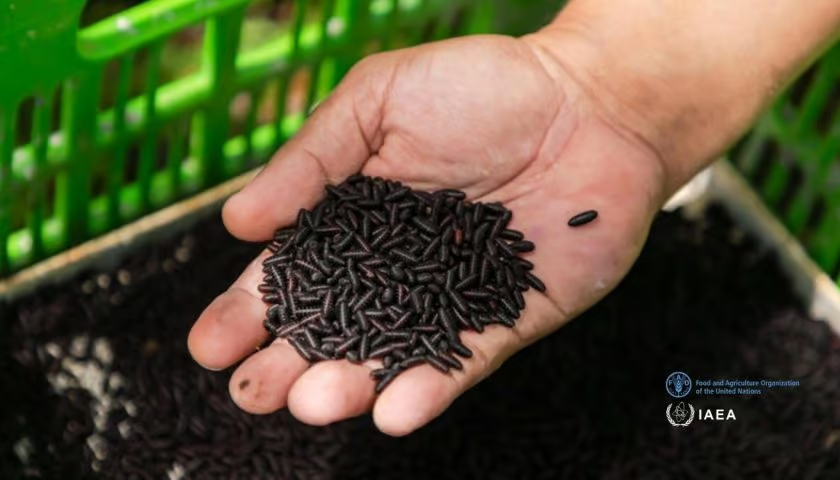
USA – The International Atomic Energy Agency (IAEA) and the FAO of the United Nations have launched a new Coordinated Research Project (CRP) to contain the re-emergence of New World Screwworm across Central America, Mexico and the United States using the Sterile Insect Technique (SIT), a nuclear-based pest control method.
The parasite, confirmed in the US in June 2026 for the first time in more than 40 years, poses a renewed threat to livestock, wildlife and regional food systems after spreading northward from Central America.
New World Screwworm is a parasitic fly whose larvae infest warm-blooded animals by entering wounds and feeding on living tissue, often causing severe infection and death if untreated.
After decades of eradication efforts, the pest re-emerged in Panama in 2022 and has since spread across the region, reaching Mexico and the United States amid shifting climate patterns and cross-border animal movement.
IAEA Director-General Rafael Mariano Grossi said, “The return of New World Screwworm is already causing serious damage in the region, threatening animals, livelihoods and economies.”
FAO Director-General QU Dongyu warned that the outbreak demonstrates how transboundary pests require coordinated scientific action, stressing that the sterile insect technique remains a proven tool used to eliminate the pest in the Americas.
The new five-year CRP, backed by a US$1 million budget, brings together experts from more than 20 countries to improve surveillance systems, mass-rearing methods, sterilisation efficiency, and field-release strategies for sterile flies.
It also aims to strengthen laboratory diagnostics and train veterinary and animal health workers to improve early detection and emergency response.
Current capacity remains a major constraint.
The Commission for the Eradication and Prevention of Screwworm facility in Panama produces about 100 million sterile flies per week, while the total demand for effective suppression is estimated at up to 600 million per week.
Planned expansions in Mexico and the United States could raise output by an additional 400 million flies, but a significant gap persists in the short term.
The previous eradication campaign, which took 45 years to complete, delivered an estimated US$1.3 billion in annual benefits to livestock producers across the region, underlining the economic stakes of renewed containment efforts.
The CRP aims to scale and refine SIT applications to prevent further spread and protect livestock systems and food security across the Americas.
Sign up HERE to receive our email newsletters with the latest news updates and insights from Africa and the World, and follow us on our WhatsApp channel for updates.


Be the first to leave a comment