

Kenya set aside US$3.6B to tackle animal feed crisis
The Kenyan government is also piloting a Livestock Master Plan to guide county-level investments based on agro-ecological conditions.
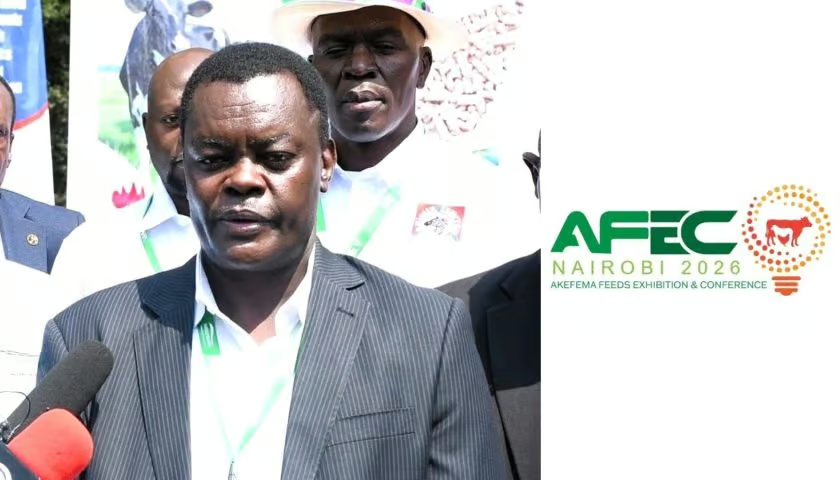
KENYA – The Kenyan government has unveiled a KSh465 billion (US$3.6 billion) investment plan to address the country’s chronic animal feed shortage, positioning feed production at the centre of efforts to improve livestock productivity, food security and rural incomes.
The investment will be implemented through the 10-year National Feed Strategy, which aims to increase the availability, quality and affordability of animal feed while encouraging greater private-sector investment across the feed value chain.
Speaking during the opening of the Association of Kenya Feed Manufacturers (AKEFEMA) Feeds Exhibition and Conference (AFEC) 2026 in Nairobi, Newton Kariuki, Head of the Animal Feeds and Nutrition Sector at the State Department of Livestock Development, described inadequate feed as the biggest obstacle to livestock production.
“Inadequate animal feed continues to be the biggest constraint to livestock productivity. Feed remains the single most important determinant of livestock productivity and competitiveness,” Kariuki said.
Kenya requires approximately 55 million metric tonnes of dry matter annually for its livestock sector, but currently produces only about 40% of that requirement, leaving an estimated 33 million metric tonnes of feed deficit.
Feed costs account for 70%-80% of livestock production costs, making animal production increasingly expensive for farmers.
Kariuki attributed the shortfall to low forage productivity, expensive raw materials, post-harvest losses, weak supply chains, limited adoption of research findings and insufficient investment in modern feed production technologies.
He also raised concerns over the quality of animal feed in the market, citing cases of adulterated and poorly labelled products.
“Farmers deserve quality feed because consumers deserve safe animal products. Whatever goes into the animal eventually finds its way onto our tables,” he said.
Strategy targets local feed production and innovation
Under the National Feed Strategy, the government plans to develop 14 priority feed value chains, including pasture, fodder crops, sunflower, cotton and maize silage, while promoting investment in feed manufacturing and raw material production.
A key component of the strategy is the One Ward, One Feed Initiative, which aims to generate approximately 300,000 metric tonnes of additional dry matter annually by 2028 across Kenya’s 1,450 wards.
The programme is expected to reduce recurring feed shortages that contribute to livestock losses during droughts.
The government is also considering establishing a Strategic National Feed Reserve to store hay, silage and fodder during surplus seasons for use during drought emergencies.
Kariuki added that biotechnology and climate-smart innovations will play an important role in strengthening feed security.
He called for science-based discussions on genetically modified feed ingredients, noting that Bt cotton has already increased cotton yields while providing additional cottonseed cake for livestock feed.
To reduce dependence on imported feed ingredients, he urged feed manufacturers to expand contract farming programmes for soybean and sunflower while encouraging counties to prioritise feed and fodder development.
According to AKEFEMA Chairman Joseph Karuri, Kenya’s feed industry comprises about 400 feed millers, producing approximately 2.5 million metric tonnes of compounded feed annually, well below the country’s installed capacity of 4 million metric tonnes.
Speaking during the conference, held under the theme “Unlocking Africa’s Livestock Productivity Through Technological Innovation in Feed Production,” Karuri said improving ingredient quality and increasing domestic production will be critical to enhancing livestock performance and supporting the country’s growing demand for animal protein.
Sign up HERE to receive our email newsletters with the latest news updates and insights from Africa and the World, and follow us on our WhatsApp channel for updates.

Be the first to leave a comment