

Senegal to build first pig feed factory in Casamance to boost local production
Authorities believe that the pig feed plant will not only support the region’s farmers but also enhance national food security and create new economic opportunities.
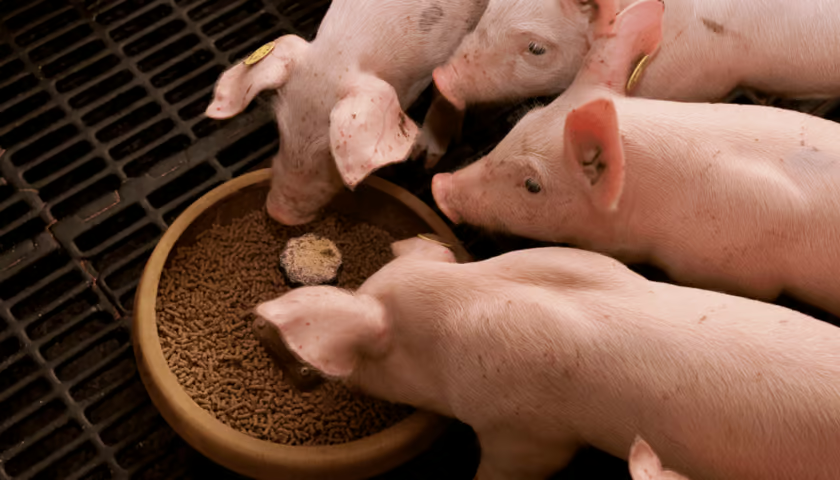
SENEGAL – Senegal’s Ministry of Agriculture has announced plans to establish a new feed manufacturing factory dedicated to pig farming in Ziguinchor, Casamance, the country’s main pig production hub.
The initiative, unveiled on November 2 by Dame Sow, coordinator of the National Integrated Livestock Development Program in Senegal (PNDIES), is designed to address one of the sector’s most persistent challenges: the high cost and limited availability of animal feed.
“This modern infrastructure will help support a sector that provides a livelihood for hundreds of families in the region. The price of feed remains a major obstacle for our farmers. This project can revive local production,” said Mr. Sow.
While details on the plant’s site, capacity, and investment cost have not yet been disclosed, the project is expected to significantly improve feed access for pig producers in southern Senegal.
The livestock sector as a whole contributes about 4% to Senegal’s GDP and supports nearly one-third of households. However, pig farming remains largely informal and underdeveloped despite its economic potential.
The government has recently shown growing interest in formalizing and expanding the sector.
In July, the National Fund for Agro-Sylvo-Pastoral Development convened a meeting with stakeholders to create a roadmap for structuring pig production into an interprofessional organization. This latest feed plant project reflects that broader policy commitment.
According to official statistics, Senegal’s pig population is estimated at around 700,000 head, generating a market value of approximately 70 billion CFA francs (US$123 million). About 20% of this value comes from exports to neighboring countries such as Cape Verde and Guinea-Bissau.
In 2022, pig meat accounted for 5.31% of total meat production, ranking fifth behind poultry (44.77%), cattle (29.49%), sheep (13.92%), and goats (6.50%), from a total output of 320,619 tonnes.
Authorities believe that the forthcoming pig feed plant in Ziguinchor will not only support the region’s farmers but also enhance national food security and create new economic opportunities.
By strengthening feed supply and reducing dependence on costly imports, Senegal aims to empower smallholder producers and stimulate local agribusiness growth.
The project also aligns with the government’s broader livestock development agenda under PNDIES, which prioritizes integrated, locally anchored solutions to increase productivity, resilience, and rural incomes.
Feed manufacturing momentum in Casamance
The planned factory in Ziguinchor follows other recent investments in animal feed production in the Casamance region.
In 2023, the National Network of Development Actors (RENAD) completed a feed plant in Niaguis, Ziguinchor, valued at 42 million CFA francs (US$73,800).
Funded by the Delegation for Rapid Entrepreneurship (DER), the unit produces 200 tons of fish feed per hour and 1 ton of livestock and poultry feed per hour.
“We thought of creating this plant financed by the Delegation for Rapid Entrepreneurship (DER) to be able to supply our ponds. And, to supply this factory with electricity, we decided to put on our own funds a power line worth 16.5 million CFA francs (US$29,000) and build a mini-borehole to be self-sufficient in water,” explained RENAD’s coordinator.
The facility is part of an “integrated aquaculture complex” aimed at promoting sustainable aquaculture and rural development in Casamance.
Under this initiative, RENAD plans to build 320 aquaculture ponds and install 10,000 oyster garlands by 2025, combining aquaculture, crop production, and feed manufacturing to create local value chains.
Sign up HERE to receive our email newsletters with the latest news updates and insights from Africa and the World, and follow us on our WhatsApp channel for updates.


Be the first to leave a comment