

Miami researchers explore sargassum-to-feed solution using black soldier flies
The research could support new applications in aquaculture and agriculture.
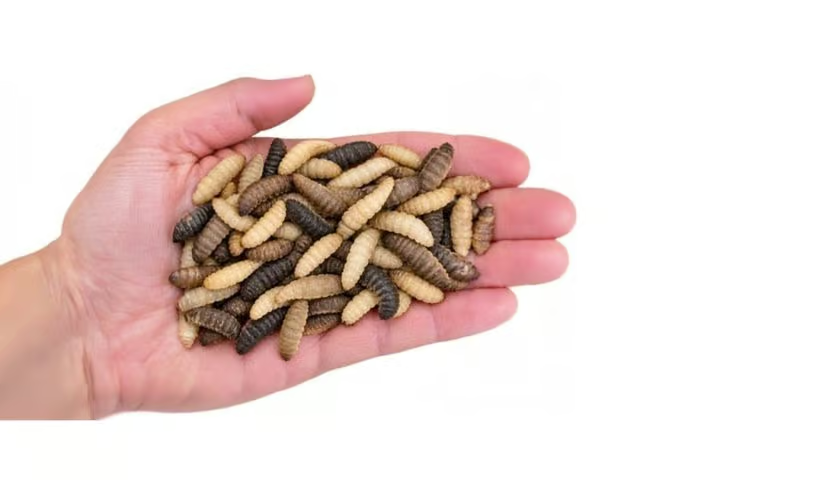
USA – Researchers at the University of Miami are investigating whether black soldier fly larvae (BSFL) can convert beached sargassum seaweed into sustainable feed ingredients and fertiliser, as record-breaking seaweed accumulations continue to affect South Florida’s coastline.
The project is supported by more than US$320,000 in seed funding from Florida Sea Grant and the Hinkley Center for Solid and Hazardous Waste Management.
The research team at the University of Miami Rosenstiel School of Marine, Atmospheric, and Earth Science is developing a system in which BSFL and other biological decomposers could process sargassum while helping remove contaminants such as arsenic.
“Our goal is not just to provide a solution to reducing sargassum impacts to our shoreline, but to help redesign Florida’s response to it,” said Daniel Benetti, professor in the Department of Marine Biology and Ecology and director of aquaculture at the Rosenstiel School.
“Instead of treating it as waste, our scalable system will convert it into valuable products for aquaculture, agriculture, and emerging bio-based industries.”
The team is assessing whether BSFL can safely convert the seaweed into insect biomass suitable for use as an animal feed ingredient, while the remaining frass could be used as a nutrient-rich organic fertiliser.
Turning coastal waste into aquafeed
The project builds on previous research by the Rosenstiel School’s Aquaculture Nutrition and Biotechnology Laboratory into BSFL as a functional ingredient in fish feed.

Researchers previously found that larvae raised on plant-based substrates contained higher levels of polyphenols, suggesting that beneficial compounds from waste materials could be transferred into insect biomass.
BSFL are increasingly being explored as an alternative protein source for aquaculture, poultry and pet food.
Their ability to convert organic waste into protein has positioned insect meal as a potential alternative to conventional marine ingredients such as fishmeal.
However, the Miami researchers are focusing on an additional challenge: ensuring that contaminants present in sargassum do not transfer into the resulting feed ingredient or fertiliser.
The Hinkley Centre-funded research, conducted with University of Miami College of Engineering professor Helena Soto-Gabriele, will evaluate BSFL and other decomposers, including worms, for their ability to remove arsenic from the seaweed during processing.
The researchers are developing a controlled BSFL rearing system designed to monitor the bioconversion process, reduce pathogen loads and limit the transfer of undesirable elements.
Sargassum is an important marine habitat while floating offshore, but large quantities that wash onto Florida beaches can accumulate, decompose and release hydrogen sulfide gas.
The resulting beach management costs also affect tourism and coastal businesses.
The research team aims to develop modular, containerised BSFL systems that could process beached sargassum directly in affected coastal communities.
If successful, the approach could turn a coastal waste problem into a source of insect protein and organic fertiliser while reducing disposal requirements and creating new feed ingredients for the aquaculture sector.
“We’re turning an environmental burden into a coastal value solution,” Benetti said.
Sign up HERE to receive our email newsletters with the latest news updates and insights from Africa and the World, and follow us on our WhatsApp channel for updates.


Be the first to leave a comment