

New strategy targets chronic feed shortages across the Horn of Africa
The feed shortage concern is a significant crisis in most of the continent, and Nigeria recently issued a similar decry concerning livestock feed shortages.
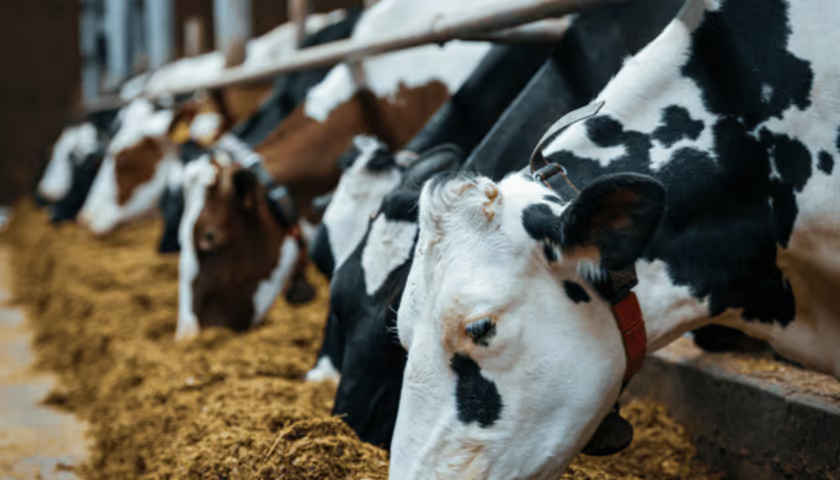
KENYA – A high-level regional workshop held in Naivasha, Kenya, from 10–13 November 2025, underscored the urgency of addressing the Horn of Africa’s chronic livestock feed shortages, which continue to undermine livelihoods and regional food security, despite the region being home to more than half of Africa’s livestock.
Convened by AU-IBAR through the African Pastoral Markets Development (APMD) Platform, the meeting gathered government officials from Kenya, Ethiopia, and Somalia, alongside researchers, private investors, and pastoral community leaders, to chart practical steps toward a more resilient feed and rangeland system.
The Horn of Africa’s livestock base, comprising 118 million cattle, 100 million goats, 104 million sheep, and 14 million camels, accounts for roughly half of Africa’s herd population.
Yet productivity remains low as low-quality natural pastures and crop residues dominate feed availability.
Kenya currently faces a 60 percent feed deficit, equivalent to 2.6 billion missing bales annually, while rapid land conversion, invasive species, and erratic rainfall continue to degrade rangelands across the region.
Participants highlighted the East Africa Feed and Feeding Strategy (2023–2037) as the region’s most comprehensive roadmap, designed to expand feed and water availability, improve utilization, promote value addition, and build climate resilience through innovation, gender inclusion, and youth engagement.
Described as a framework that “offers policy convergence that lowers entry barriers for private capital,” the strategy aligns with AU and FAO priorities and targets a long-standing regional feed deficit.
Complementing this is IGAD’s Regional Fodder and Rangeland Platform (RFRP), which has already delivered participatory rangeland management guidelines, a pasture seed production manual, and capacity building for cross-border communities.
Delegates emphasized the platform’s potential to develop a regional feed information system, harmonize quality standards, and anchor long-term investment partnerships.
“The platform offers an ecosystem for an increasingly organized, transparent, and long-term engagement,” one official said.
Country realities and investment prospects
Kenya’s annual feed demand stands at 55 million metric tons of dry matter, more than twice the current supply, leaving herds underfed and producers vulnerable to drought-related volatility.
Ethiopia faces similar constraints, driven by shrinking grazing land, weak forage seed systems, and limited investment in feed technologies.
Its government has introduced incentives including tax breaks, infrastructure funding, and new public–private partnerships to accelerate fodder seed multiplication and rangeland restoration.
Somalia, which earns US$2.6 billion annually from live animal exports, faces a 34 percent dry-matter feed deficit, with 97 percent of its feed coming from open grazing, a system highly exposed to drought cycles.
Kenyan delegates estimated the region’s feed sector investment potential at US$3.4 billion, backed by strong demand from beef, dairy, and poultry industries.
Kenya’s feed value chain alone presents an investment case of KES 465.4 billion (US$3.03 billion), with a projected annual net return of KES 174 billion (US$1.13 billion) and capacity to create more than 145,000 jobs.
As the workshop concluded, stakeholders emphasized that operationalizing existing policies will require commercializing fodder production, scaling resilient technologies, and strengthening early warning systems.
Sign up HERE to receive our email newsletters with the latest news updates and insights from Africa and the World, and follow us on our WhatsApp channel for updates.
Be the first to leave a comment