

Brazil adopts Cheggy in-ovo sexing technology for the first time
The Cheggy technology allows hatcheries to hatch only female chicks, eliminating the need for culling.
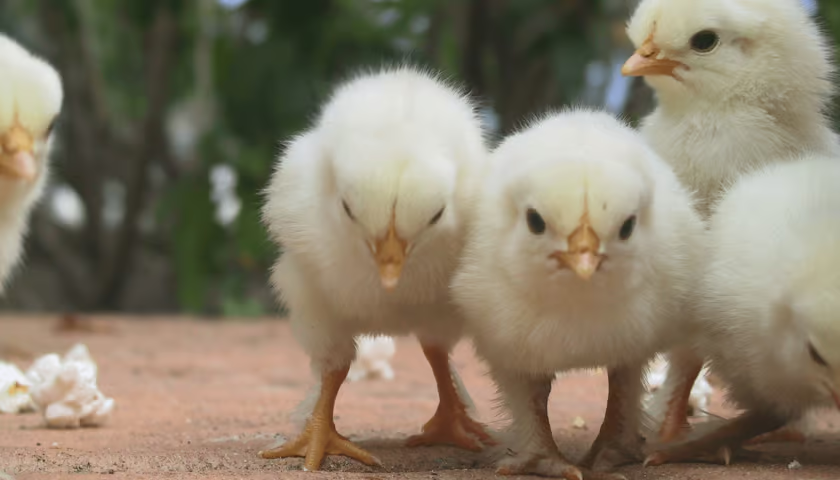
BRAZIL – Brazil has become the first country in Latin America to introduce in-ovo sexing technology, with the installation of the Cheggy machine that determines the sex of chicks while still in the egg.
The breakthrough, developed by German company Agri Advanced Technologies GmbH (AAT), a subsidiary of the EW GROUP, represents a significant step forward for animal welfare and sustainable egg production.
The milestone was officially announced on Monday, July 28, 2025, at a press event in São Paulo attended by national and international media.
Raiar Orgânicos, an organic egg producer founded in 2020, has become the pioneer adopter of the Cheggy system in Brazil and the wider Southern Hemisphere. The company confirmed that it would transition its entire flock to 100% in-ovo selected chicks.
Ending the practice of male chick culling
Traditionally, male layer chicks have been culled after hatching because they serve no role in egg production and are unsuitable for meat production.
The Cheggy technology addresses this issue by using hyperspectral imaging to detect differences in feather colouration between male and female embryos of brown layer breeds, without opening the egg. This allows hatcheries to hatch only female chicks, eliminating the need for culling.
“With our launch in Brazil, we’re expanding the range of available solutions for sustainable and humane egg production,” said Jörg Hurlin, Managing Director of AAT. “In-ovo sexing allows for early selection in the hatchery and offers a scalable, efficient approach, making it particularly suitable for large markets like South America.”
Cheggy sets a new benchmark in egg production by combining high precision with speed. The contact-free system uses deep learning methods and advanced light spectrum analysis to provide a non-invasive, commercially viable solution for hatcheries worldwide.
Raiar Orgânicos leads the way
Raiar Orgânicos has positioned itself as a pioneer in animal welfare and innovation in Brazil’s egg industry. The company’s holistic approach integrates animal welfare, regional agricultural development, and cutting-edge technology to make organic food more accessible.
“Raiar is a restless company committed to the highest standards of transparency, management, and animal welfare. That’s why we actively seek out the best market practices and solutions to improve animal welfare in egg production continuously,” said Marcus Menoita, CEO and co-founder of Raiar.
“The in-ovo sexing technology provided by Cheggy is the most effective, non-invasive, and viable solution available.”
The introduction of Cheggy also aligns with shifting consumer expectations. A January 2025 survey by Innovate Animal Ag showed that Brazilian consumers are increasingly aware of animal welfare issues and value alternatives to male chick culling.
“Raiar Orgânicos is setting an inspiring example of what forward-thinking leadership looks like in animal agriculture,” said Robert Yaman, Managing Director of Innovate Animal Ag.
“As in-ovo sexing becomes a global trend, we’re excited to see companies like Raiar not only embrace the change but help drive it.”
The arrival of Cheggy in Brazil marks another stage in AAT’s global rollout. Following successful launches in Germany, France, Italy, the Netherlands, and the United States, Brazil is now the first country in the Southern Hemisphere to adopt the technology.
Sign up HERE to receive our email newsletters with the latest news updates and insights from Africa and the World, and follow us on our WhatsApp channel for updates.

Be the first to leave a comment