

ADM Partners with Hill’s Pet Nutrition in North America and EMEA
ADM, Hill’s expand regenerative agriculture programme as Ukraine oilseed plant remains suspended.
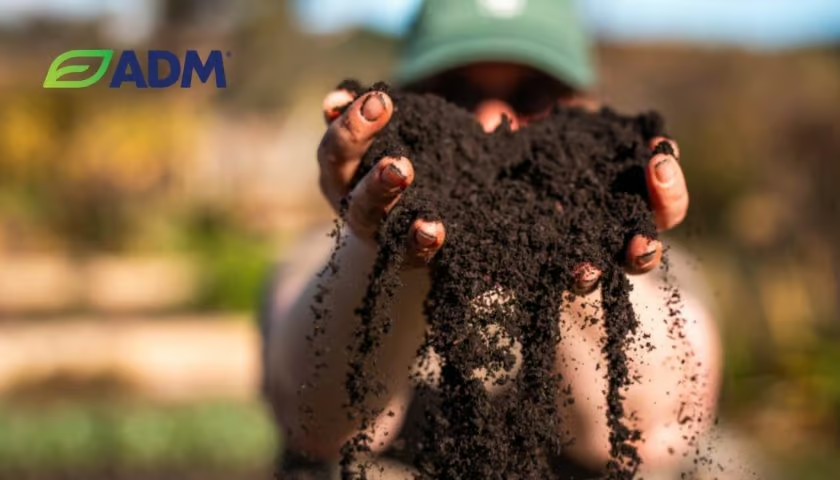
GLOBAL – Archer Daniels Midland (ADM) and Hill’s Pet Nutrition are expanding a regenerative agriculture programme covering 16,000 acres of corn and soybean fields in the United States and 2,500 acres of soybean production in Hungary, as the companies work to strengthen sustainability across the pet food supply chain.
The initiative is designed to accelerate the adoption of regenerative farming practices for crops used in pet food production, while improving environmental outcomes and supporting farmers through financial and technical incentives.
ADM said the programme will engage, educate, and incentivise farmers to adopt practices that enhance soil health, biodiversity, water retention, and climate resilience.
Hungary was selected as a key European pilot location due to its role in ADM’s soybean sourcing network.
The programme will run as part of ADM’s broader “regenerations” initiative, which supports outcome-based farming systems focused on long-term soil and ecosystem health.
ADM defines regenerative agriculture as an outcome-based approach that protects and improves soil health, biodiversity, climate, and water resources while also creating market opportunities and added value for farmers.
Its core principles include responsible use of inputs, continuous soil cover, reduced soil disturbance, enhanced biodiversity, and maintenance of living roots in the soil.
Farmers participating in the programme will receive financial incentives for adopting regenerative practices.
These payments are intended to offset transition costs and reward measurable environmental improvements.
ADM will also manage data collection, field monitoring, and impact reporting to verify environmental and economic outcomes.
In addition, the company will provide technical support, agronomic guidance, field education, and peer networking opportunities to help farmers implement regenerative systems at scale.
Hill’s Pet Nutrition said the collaboration reflects its focus on science-led nutrition and sustainability from the ground up.
“Because grains like corn and soy are foundational to our recipes, partnering with ADM to support regenerative farming is a natural extension of our purpose of reimagining a resilient future for all people, their pets and our planet,” said Dave Baloga, executive vice president of science and technology at Hill’s Pet Nutrition.
Greg Morris, senior vice president and president of ADM’s ag services and oilseeds business, said farmers are central to the pet food supply chain and the initiative helps align environmental performance with ingredient sourcing.
“Farmers are at the heart of our pet food system, and this partnership enables us to support regenerative agriculture while sourcing high-quality ingredients grown with care for the land,” Morris said.
ADM said it has already surpassed its 2025 target of transitioning 5 million acres to regenerative agriculture a year ahead of schedule, according to its latest sustainability report.
Ukraine’s oilseed plant remains suspended after drone strike damage
Separately, ADM confirmed that operations at its oilseed crushing facility in Chornomorsk, Ukraine, remain suspended following damage from a Russian drone strike on April 26, 2026.
The company said one storage tank was damaged, causing a partial oil spill, while several other tanks were also hit by shrapnel.
Assessment and repair work are currently underway.
“The safety of our employees remains our highest priority, and we continue to monitor the situation closely,” ADM said in a statement.
The suspension adds to ongoing disruptions faced by global agribusiness companies operating in Ukraine amid the war.
Industry reports indicate that multiple multinational firms have seen assets damaged or operations disrupted, including facilities linked to Cargill, Bunge, Coca-Cola, Mondelēz, Philip Morris, and Boeing.
ADM’s Ukraine footprint has also been contracting in recent months.
The company recently completed the sale of its Kamianskyi grain elevator in the Cherkasy region, a 64,000-tonne storage facility, to OLIMP following approval from Ukraine’s Antimonopoly Committee.
With this sale, ADM no longer holds direct grain storage assets in the country.
Another facility, the Tavriiskyi elevator, was previously destroyed during the conflict.
The developments highlight a dual reality for ADM: expanding investment in regenerative agriculture and sustainable sourcing in core supply chains, while simultaneously managing significant operational risks in conflict-affected regions.
Sign up HERE to receive our email newsletters with the latest news updates and insights from Africa and the World, and follow us on our WhatsApp channel for updates.

Be the first to leave a comment