

Kenya hands over Bachuma livestock export zone to private operator
Kenya’s Bachuma livestock export zone is set to support disease surveillance, traceability and access to international livestock markets.
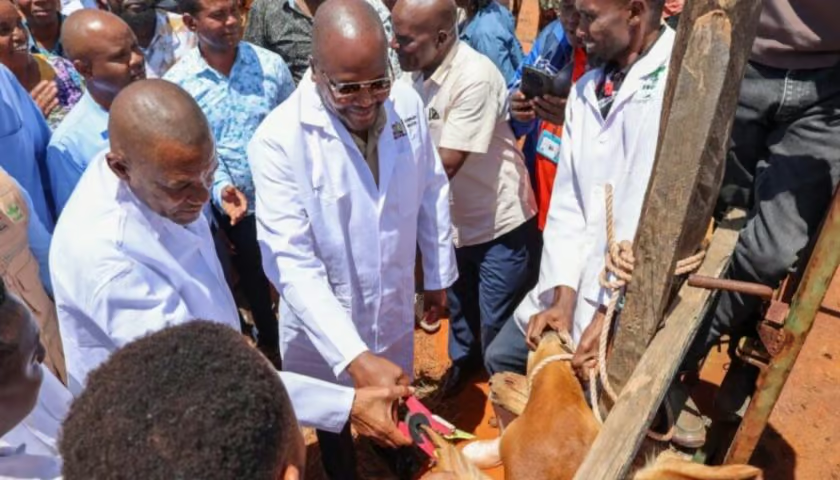
KENYA – Taita-Taveta County has handed over the Bachuma Livestock Export Processing Zone (LEPZ) to Blue Mountain Meat and Livestock Limited, advancing the operationalisation of a facility designed to strengthen livestock quarantine, disease surveillance and export certification.
The Bachuma Livestock Quarantine Station (BLQS) was conceived under Kenya’s Vision 2030 to support the country’s livestock export capacity.
Construction began in 2015, but the project faced prolonged delays.
The government now plans to use the facility for livestock quarantine, disease surveillance, animal identification and traceability, and veterinary certification in line with international animal-health requirements.

Agriculture Cabinet Secretary Mutahi Kagwe said collaboration between the national government, Taita-Taveta County and the private sector would create opportunities for farmers, traders and investors while supporting Kenya’s access to international livestock markets.
Officials said an offtake arrangement could absorb up to 100,000 cattle annually, while a separate order for goats and sheep from South African buyers was valued at about KES2 billion (US$15.5 million).
The overall potential of the facility has been estimated at nearly KES30 billion (US$232 million).
The government also plans to register 15,000 farmers under the County Livestock Investment Company model to establish a structured supply of animals for export.

Under the model, farmers will contribute 30% of the KES10,000 (US$77) shareholding cost, equivalent to KES3,000 (US$23), while the national government will contribute the remaining KES7,000 (US$54).
The initiative is intended to give farmers ownership stakes in livestock aggregation while linking them to export markets. Returns could be distributed through dividends or bonuses.
Strengthening livestock traceability
Kagwe also launched the Animal Identification and Tracing system, known as AniTrac, during the event.
The digital system is designed to strengthen livestock traceability and disease surveillance while helping combat livestock theft.
It will also support compliance with animal-health requirements in international export markets.
Livestock quarantine and veterinary certification have been identified as important requirements for Kenya to restore and expand access to overseas markets, including destinations in the Middle East.
Taita-Taveta Governor Andrew Mwadime said the county would work with Blue Mountain Meat and Livestock to expand livestock processing and value addition.
“Our vision goes beyond livestock market. We want to build a complete livestock value chain that supports processing, job creation, manufacturing and industrial growth,” Mwadime said.
The Bachuma project forms part of Kenya’s wider efforts to increase livestock exports and develop infrastructure supporting the livestock and leather value chains.
Its focus on animal health, traceability and certification is also expected to strengthen the systems required for livestock movement and international trade.
Sign up HERE to receive our email newsletters with the latest news updates and insights from Africa and the World, and follow us on our WhatsApp channel for updates.

Be the first to leave a comment