

Mars reaches 100% renewable electricity milestone in U.S.
In 2025, Mars expanded its climate-smart agriculture portfolio to 77 projects across 26 countries and 12 crops.
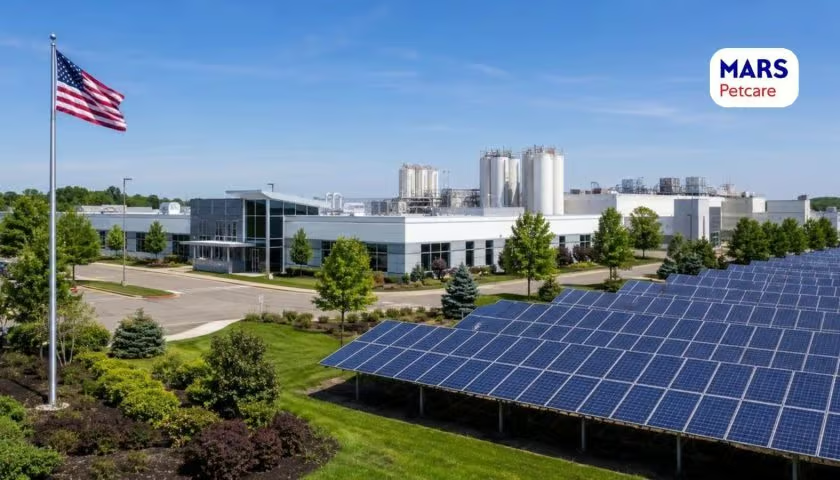
USA – Mars, Incorporated has achieved 100% renewable electricity across all its U.S. operations, marking a major milestone in its sustainability strategy as the company continues to reduce greenhouse gas emissions while expanding investments in climate-smart agriculture and resilient ingredient supply chains.
The milestone, announced in the company’s 2025 Sustainable in a Generation Report, covers factories, offices, veterinary hospitals and diagnostic laboratories across the United States.
It contributed to a 42.6% reduction in the company’s Scope 1 and 2 greenhouse gas emissions compared to its 2015 baseline.
Across its entire value chain, Mars reported a 6.4% reduction in emissions during 2025. This brings its cumulative absolute emissions reduction to 16.9% since 2015, despite growing the business by approximately 75% over the same period.
Mars CEO Poul Weihrauch said access to clean energy is becoming increasingly important for building resilient businesses and supporting agricultural communities facing climate-related challenges.
He said the renewable electricity milestone reflects the company’s commitment to creating resilient supply chains, supporting farming communities and investing in a more sustainable future.
The company is also scaling its Renewables Acceleration (RAcc) programme, launched in 2025, to extend renewable electricity beyond its own facilities into supplier operations.
A new agreement with Enel North America will support three solar projects in Texas expected to generate approximately 1.8 terawatt-hours of renewable electricity annually.
The projects will supply renewable energy for both Mars operations and parts of its supplier network.
Climate-smart agriculture expands across global supply chains
Alongside renewable energy investments, Mars continued expanding climate-smart agriculture projects that support the production of key crop ingredients used across its food and petcare businesses.
The company now operates about 77 climate-smart agriculture projects across 26 countries, covering 12 different crops.
Among the largest initiatives is a US$20 million investment in its Raising Rice Right programme running from 2020 to 2030.
The programme promotes sustainable rice production, farmer training and climate resilience.
Mars has also invested approximately US$5.2 million over five years to develop drought- and disease-resistant peanut varieties that can help farmers adapt to changing weather conditions.
In Europe, Mars partnered with PepsiCo and ADM to launch a regenerative agriculture programme in Poland supporting 24 farmers across more than 5,450 hectares.
The initiative includes regenerative wheat production across 3,450 hectares, supplying ingredients for Mars pet food brands such as WHISKAS® and PEDIGREE®.
Chief Sustainability Officer Alastair Child said sustainability continues to shape how the company plans, invests and operates, adding that collaboration across suppliers, governments and industry partners remains essential for delivering measurable environmental progress.
Mars also announced plans to invest an estimated US$2 billion in U.S. manufacturing and US$1.14 billion in European Union operations by the end of 2026.
The company additionally launched a US$250 million Mars Sustainability Investment Fund to accelerate sustainability innovation and strengthen long-term resilience across its global value chain.
Sign up HERE to receive our email newsletters with the latest news updates and insights from Africa and the World, and follow us on our WhatsApp channel for updates.

Be the first to leave a comment