

Senegal’s tsetse eradication programme transforms livestock production
The programme has reduced tsetse fly populations in the Niayes region by more than 99%, effectively eliminating trypanosomosis from most areas.
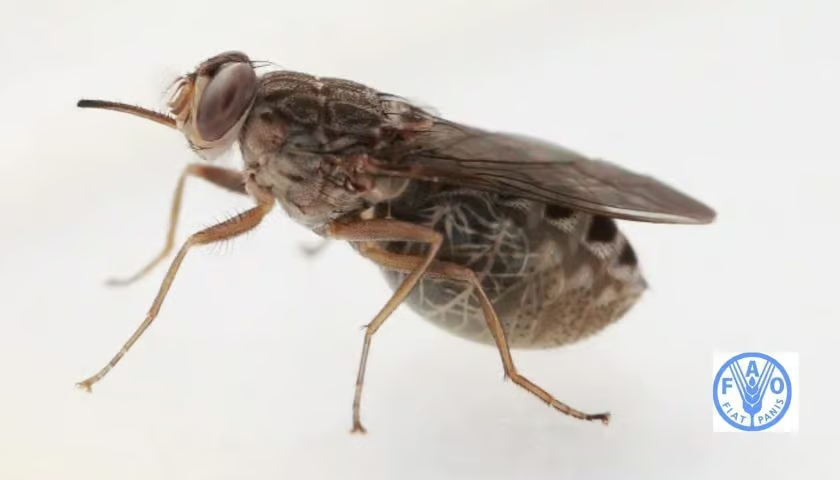
SENEGAL – Senegal has reduced tsetse fly populations in the Niayes region by more than 99%, transforming livestock production, improving household incomes and accelerating dairy development after more than a decade of coordinated disease control efforts supported by the Food and Agriculture Organization (FAO) and the International Atomic Energy Agency (IAEA).
The programme, led by the Government of Senegal with technical support from the Joint FAO/IAEA Centre of Nuclear Techniques in Food and Agriculture, combined conventional vector control measures with the Sterile Insect Technique (SIT), a nuclear-based method that suppresses insect populations by releasing sterilised male flies.
The campaign targeted trypanosomosis, a disease transmitted by tsetse flies that had severely constrained livestock production across the Niayes region.
Before the intervention, infection rates reached as high as 28% in some cattle herds.
Farmers relied mainly on disease-tolerant local breeds with relatively low productivity. The disease reduced milk yields, increased livestock mortality and limited household incomes.
The campaign began with feasibility studies in 2006 before moving into operational implementation in 2012.
It was carried out in partnership with the Institut Sénégalais de Recherches Agricoles (ISRA), Senegal’s national veterinary services and France’s Centre de coopération internationale en recherche agronomique pour le développement (CIRAD).
Additional financial support came from the United States and France through the IAEA Peaceful Uses Initiative.
Dairy production surges after disease control
Two socio-economic assessments conducted after more than ten years of field implementation found that the elimination of tsetse flies has fundamentally changed livestock production systems in the region.
Exotic cattle breeds, which accounted for only 1.5% of herds before the programme, now represent more than 27% in some farming systems.
Farmers have also shifted towards smaller but more productive herds, with herd sizes declining by up to 49% as production becomes increasingly commercial and efficient.
Modern dairy farming has expanded rapidly.
Since 2017, 904 modern dairy farms have been established in the Niayes region, representing nearly three-quarters of Senegal’s modern dairy operations.
Milk production has increased significantly.
Sales have risen from about 157 litres to more than 2,100 litres per cow annually in some farming systems.
Government-supported programmes have also introduced more than 11,900 exotic cattle, including nearly 6,000 dairy cows.
Milk production from these animals increased from 4.3 million litres in 2018 to 62.5 million litres in 2024.
The studies also recorded a 45% increase in household income from livestock production and a 61% rise in milk sales income.
Treatment costs for trypanosomosis declined by 63%, while cattle mortality and disease rates fell sharply.
“The assessments provide clear evidence that vector suppression has transformed livestock production systems in the Niayes region, with significant improvements in productivity, income and animal health,” said Adji Maréme Gaye, Epidemiologist at the FAO office in Senegal.
The programme has also created wider economic benefits by stimulating dairy processing, distribution and employment opportunities, particularly for women and young people.
“Conventional vector control could suppress tsetse populations, but it was the sterile insect technique that allowed Senegal to push past suppression toward eradication, breaking the cycle of reinfestation for good,” said Chantel De Beer, Technical Officer at the Insect Pest Control Laboratory of the Joint FAO/IAEA Centre.
Experts say continued surveillance will be essential to protect the gains achieved.
Regular monitoring, livestock screening and community participation will help prevent any resurgence of the pest while supporting the long-term sustainability of Senegal’s increasingly productive livestock sector.
Sign up HERE to receive our email newsletters with the latest news updates and insights from Africa and the World, and follow us on our WhatsApp channel for updates


Be the first to leave a comment