

Kenya livestock reforms shift toward aggregation, feed efficiency and export-driven value chains
Kenya’s livestock base remains one of the largest in Africa, forming the backbone of livelihoods in arid and semi-arid regions.

KENYA – Kenya is accelerating reforms in its livestock sector aimed at transforming pastoral and smallholder production into a structured, commercially driven system anchored on aggregation, feed efficiency, and export competitiveness, Principal Secretary for Livestock Development Jonathan Mueke has said.
Speaking during the Fixing The Nation discussion, Mueke outlined a series of ongoing government interventions, including vaccination programmes, feedlot development, livestock traceability systems, and cooperative-based aggregation models designed to improve productivity and unlock value across the livestock feed and meat value chain.
He noted that Kenya’s livestock base remains one of the largest in Africa, with 22 million heads of cattle, 35 million goats, 28 million sheep, and about 6 million camels, forming the backbone of livelihoods in arid and semi-arid regions.
“These numbers show the scale of opportunity we have. But the challenge is not just ownership of livestock, it is how we commercialise it,” Mueke said.
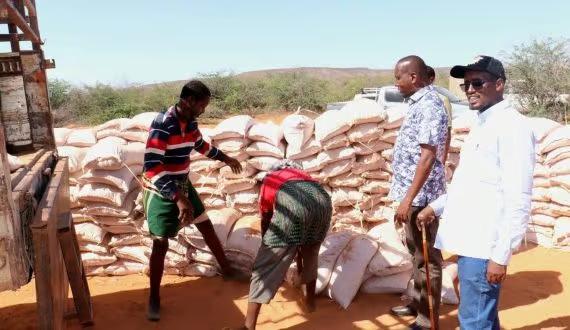
A key pillar of the reforms is the creation of county-level livestock investment companies, which the government says will help address long-standing fragmentation among pastoral producers and improve market access.
“We are calling it a county livestock investment company. We will aggregate about 15,000 livestock keepers per county across 21 ASAL counties, capitalise them, and organise them into structured commercial entities that can supply consistent volumes and quality to the market,” Mueke said.
The model, which is expected to mobilise more than 300,000 pastoralists in its first phase, is part of a broader push to shift livestock production from subsistence to enterprise-based systems similar to Kenya’s tea and dairy value chains.
Feed and nutrition systems

The government is also addressing long-standing feed constraints that continue to limit productivity across poultry, dairy, and pig systems.
Officials estimate Kenya’s feed deficit at more than 50%, with high feed costs remaining a key barrier to commercial livestock production.
In the pig subsector, Mueke said the government is working with industry players, including Farmers Choice, to promote consumption and production through a campaign dubbed “Pork Power”.
“Pork has been a little difficult for us because the production cost is high due to high animal feed costs.
We have partnered with leading pork producers and started a campaign called Pork Power to encourage consumers to recognise pork as a cheaper source of protein,” he said.
The government is also investing in model feedlots, which will serve as fattening and finishing centres to increase carcass weight and improve meat quality for export markets.
Officials say this could significantly raise farmer incomes by shifting animals from raw off-take to value-added finishing systems.
Disease control remains another key intervention, particularly through mass vaccination programmes targeting Foot and Mouth Disease (FMD), which has previously limited Kenya’s access to premium export markets.
“We have already vaccinated over 13 million animals, and the impact is clear. Export volumes have increased by more than 70 per cent because markets now have greater confidence in the safety and traceability of our livestock products,” Mueke said.
He added that the introduction of an animal identification and traceability system will further strengthen market access by ensuring compliance with international sanitary and phytosanitary standards.
The livestock sector contributes about 12 per cent of Kenya’s GDP and nearly half of agricultural GDP, with officials targeting an expansion of its share to 20 per cent by 2030 through improved productivity and commercialisation.
The PS says the reforms could reshape demand patterns in the feed sector, particularly as feedlots, aggregation hubs, and commercialised production systems increase demand for formulated feeds, supplements, and animal health inputs.
However, Mueke acknowledged that successful implementation will depend heavily on stakeholder engagement and trust-building with pastoral communities, many of whom traditionally view livestock as a store of wealth rather than a commercial asset.
“We must carry farmers with us. Communication, sensitisation, and demonstrating value will be critical for this transformation to succeed,” he said.
The reforms come as Kenya positions its livestock sector to compete more effectively in regional and global markets, particularly in the Middle East, where demand for certified, traceable meat products continues to grow.
If fully implemented, the shift could significantly expand Kenya’s feed manufacturing industry while strengthening integrated value chains across livestock production, animal health, and meat processing.
Watch the full interview here.
Sign up HERE to receive our email newsletters with the latest news updates and insights from Africa and the World, and follow us on our WhatsApp channel for updates.

Be the first to leave a comment