

Native phages hold promise for New Zealand aquaculture health
Advances in bacteriophage (phage) science are now opening new pathways for effective, environmentally friendly disease control.
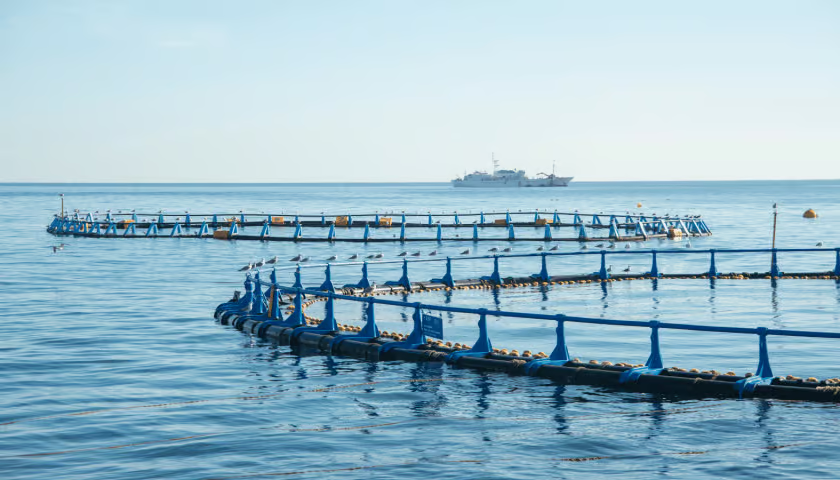
NEW ZEALAND – New Zealand researchers are pioneering the use of bacteriophages (viruses that infect and destroy bacteria) as sustainable, antibiotic-free solutions to combat bacterial diseases in aquaculture, according to an article by Suzi Dominy on We Are Aquaculture.
The breakthrough, unveiled at the Aquaculture New Zealand 2025 Conference in Nelson, could transform fish and shellfish farming while supporting the country’s goal of expanding its aquaculture industry.
Bacterial pathogens are responsible for more than 10% of losses in New Zealand’s food and animal production.
But advances in bacteriophage (phage) science are now opening new pathways for effective, environmentally friendly disease control.
Heather Hendrickson, Associate Professor of Microbiology at the University of Canterbury, is co-leading a NZ$9 million (US$5.4 million) research initiative funded by the Ministry of Business, Innovation and Employment (MBIE) Endeavour Fund.
Launched in 2023, the five-year programme, run jointly with Professor Peter Fineran of the University of Otago’s Phage-host interactions laboratory, develops adaptable phage-based biocontrols for aquaculture, horticulture, and apiculture.
The project is advancing into scale-up and formulation stages with industry partners BioSouth and the Callahan Institute.
“Social license is very important in New Zealand,” Hendrickson said. “We’ve undertaken extensive market testing and Māori engagement to understand how New Zealanders actually feel about this kind of technology.”
Over the past two years, Hendrickson’s team has worked with Mt. Cook Alpine Salmon to test a commercially available phage solution from overseas on Listeria monocytogenes strains found in production lines.
The product achieved a 100% kill rate on all 37 strains tested. Building on that success, the researchers began hunting for native New Zealand phages—and found five new ones, four of which outperformed imported products.
“That’s really exciting to us because it means not only do we have native New Zealand phages that perform better than something that’s commercially available from overseas, but we can use, for example, the Listeria innocua that our phages are able to amplify on,” Hendrickson explained.
“That means we can use Listeria innocua, which is a harmless Listeria strain, in order to produce large quantities of this phage.”
Expanding applications and future potential
Bacteriophages, naturally occurring and biodegradable, are already recognized as safe by the US Food and Drug Administration (FDA).
They offer targeted biocontrol while preserving beneficial microbes and can be combined to prevent bacterial resistance. In aquaculture, studies have shown they can reduce mortality in oysters, salmon, and trout.
The methods of application vary depending on the species and production stage—via immersion in water, oral delivery through feed, injection for larger fish, or surface spraying to control biofilms.
Hendrickson’s group has also identified phages with unique binding sites in their protein shells, allowing them to adhere to mucins on fish skin.
Another project focuses on the green-lipped mussel (Perna canaliculus) industry, investigating whether microbial sequencing and environmental data can help predict pathogen outbreaks.
Researchers hope to identify phages that could act as targeted biocontrols against forecasted bacterial threats, improving resilience in one of New Zealand’s most valuable aquaculture sectors.
Industry and policy align for growth
The promise of phage biocontrols comes as the aquaculture industry seeks to scale up. At the same conference, Oceans and Fisheries Minister Shane Jones called for tailored regulation and expanded ocean farming zones to help aquaculture reach parity with the country’s beef sector.
He emphasized the need for increased investment and legislative reform to achieve the government’s target of NZ$3 billion (US$1.8 billion) in aquaculture exports within the next decade.
New Zealand King Salmon’s general manager, Grant Lovell, echoed that sentiment, noting that despite “oceans of space,” finding suitable farming zones remained difficult. “Further regulatory reform is essential to the industry’s growth and expansion,” he told delegates.
Sign up HERE to receive our email newsletters with the latest news updates and insights from Africa and the World, and follow us on our WhatsApp channel for updates.


Be the first to leave a comment