

Machine learning study projects shifting livestock capacity in East Africa
By linking remote sensing with climate projections, the approach provides policymakers with an evidence-based roadmap for designing climate-smart interventions.
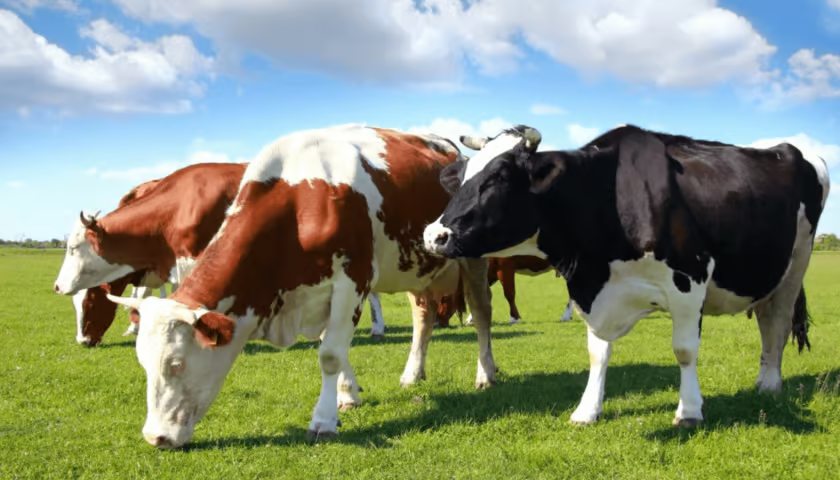
EAST AFRICA – A groundbreaking study published in Regional Environmental Change this month warns that climate change could sharply reduce livestock carrying capacity in parts of East Africa, with Ethiopia expected to face the steepest declines.
The study, led by Duku and colleagues, introduces a machine learning model that projects how rangeland productivity will shift across the region under changing climatic conditions.
The research tackles a persistent knowledge gap: how climate change will affect livestock capacity at large scales in data-scarce regions.
Traditional tools such as field surveys and process-based models often fail to capture the variability of rangelands across East Africa.
By integrating satellite-based biomass data with climate projections, the researchers modelled net primary productivity (NPP) and translated it into livestock carrying capacity, expressed in tropical livestock units (TLU).
Ethiopia and Kenya see stark contrasts

The findings reveal stark contrasts across production systems and countries. Ethiopia’s mixed crop-livestock rainfed temperate (MRT) system, home to nearly half the nation’s cattle and sheep, could lose up to 37% of its carrying capacity under a high-emissions scenario by century’s end.
“With current livestock numbers already near the MRT system’s limits, any reduction risks serious sustainability challenges,” the authors note.
Kenya’s outlook is more complex. Pastoral and arid livestock-only (LGA) systems may see gains of 11–26% in capacity, largely driven by increased precipitation during colder and wetter months.
However, the MRT and livestock-only temperate (LGT) systems are projected to shrink by 12–24% and 10–31%, respectively, which threatens regions that have long supported mixed farming.
Tanzania is expected to experience only minor shifts, with most systems gaining modestly, up to 6%, except for a projected 12% decline in the LGT system.
Uganda, meanwhile, shows overall increases, particularly in its mixed rainfed humid (MRH) systems, which could grow by 7–12%. Yet even there, MRT systems may contract by as much as 32%, reflecting the vulnerability of mixed farming systems across the region.
Climate drivers and policy implications
The machine learning approach also pinpointed climatic drivers behind these trends. In Ethiopia, higher precipitation in the wettest quarter, reduced temperature seasonality, and hotter dry-season conditions are key contributors to lower NPP and carrying capacity.
In Kenya’s pastoral systems, by contrast, greater rainfall is expected to boost productivity, though rising dry-season heat could temper gains.

CGIAR communications echoed these findings, warning that “up to 37% declines in Ethiopia’s mixed crop-livestock systems and 24% in Kenya” underscore the urgency of tailored adaptation responses.
The policy implications are significant. Ethiopia must urgently strengthen monitoring systems, invest in resilient forages, and support the livelihoods of agro-pastoralists to withstand mounting pressures.
Kenya and Uganda, the study suggests, should seize opportunities to expand sustainable, low-emissions livestock systems that align with both productivity and climate goals.
Beyond its findings, the study demonstrates the power of machine learning to produce scalable, data-driven forecasts for regions where traditional models falter.
By linking remote sensing with climate projections, the approach provides policymakers with an evidence-based roadmap for designing climate-smart interventions.
“Climate change poses a significant threat to livestock production in East Africa, with major implications for food security and rural livelihoods,” the authors conclude.
Their analysis suggests that while the future will bring uneven impacts, the tools now exist to anticipate and adapt to them, if urgent action is taken.
Sign up HERE to receive our email newsletters with the latest news updates and insights from Africa and the World, and follow us on our WhatsApp channel for updates.


Be the first to leave a comment