

Calysta appoints new CEO as FeedKind producer seeks funding to scale single-cell protein production
The current decisions show the commitment moving from a technology provider to become an actual market player in protein supply for fish feed, animal feed and petfood.
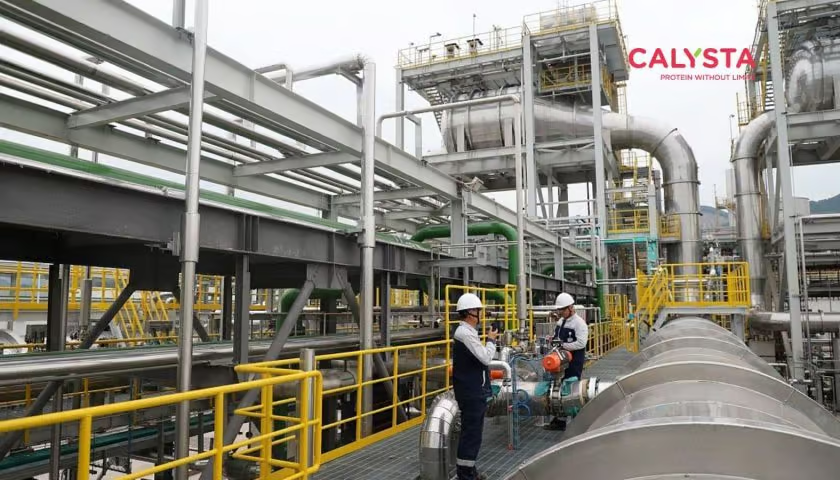
UK/CHINA – Calysta, a world leader in cellular agriculture, has appointed Berend Jan Kingma as Chief Executive Officer as the single-cell protein developer seeks fresh funding following the suspension of financial support for its Chinese joint venture, raising fresh questions about the pace of commercialising alternative feed proteins.
Kingma, who assumed the role on July 1, succeeds co-founder Alan Shaw, who becomes non-executive chairman.
He joins the company with experience leading agrifood businesses including InspiraFarms, FirstWave Group, Miro Forestry and the FrieslandCampina China joint venture.
The leadership change comes as Calysta works to secure new investment after its joint venture partner, Adisseo, announced it would not renew a loan to Calysseo, the companies’ Chinese venture that produces FeedKind, a methane-based single-cell protein for aquafeed and, soon, petfood.
In a filing on the Shanghai Stock Exchange, Adisseo said Calysseo was facing “a severe shortage of working capital” after failing to secure external financing.
According to Adisseo, the company requires significant long-term funding to complete the technical upgrades needed to resume production, and the venture faces economic challenges in the feed protein market.
Calysseo’s demonstration-scale facility in Chongqing, China, halted production recently while improvements are undertaken.
The company reported unaudited 2025 results showing US$710,000 in revenue, US$15.5 million in net losses and liabilities of US$63.9 million.
Despite the setback, Calysta says commercial demand for FeedKind continues to grow.
“Calysseo started producing FeedKind through innovative gas fermentation technology in 2024, when full approval was received by the Chinese government,” said Alan Shaw, non-executive chairman and co-founder of Calysta.
“Since then, Calysseo has proven full productivity in upstream processing, demonstrating that we can create high-quality protein through our technology. Now, we are shifting towards operational excellence by setting up the organisation and the processing for commercial success.”
Shaw said the company’s immediate priority is improving downstream processing efficiency.
“The focus in the factory is on debottlenecking downstream processing. This will enable higher throughput at the designed capacity and, correspondingly, lower the cost of goods produced. We are finalising restructuring of our organisation and raising the funds needed to implement the necessary investments,” he said.
Alternative proteins remain a strategic feed opportunity
For the feed industry, FeedKind represents one of a growing number of single-cell proteins (SCPs) being developed as alternatives to fishmeal and soybean meal.
Produced through gas fermentation using methane, the ingredient targets aquafeed and petfood markets seeking more sustainable protein sources.
According to Calysta, thousands of tonnes of FeedKind have already been supplied to China’s aquafeed sector since commercial production began in 2024, with demand supported by high fishmeal prices.
The company also expects approval to enter China’s pet food market in the third quarter of 2026.
While financing and scale-up remain major challenges for gas fermentation companies, the technology continues to attract interest as feed manufacturers seek novel protein sources that reduce dependence on conventional marine and crop-based ingredients.
Recent investments by companies including Unibio and Solar Foods underscore continued confidence in the sector despite commercial hurdles faced by several early-stage developers.
Sign up HERE to receive our email newsletters with the latest news updates and insights from Africa and the World, and follow us on our WhatsApp channel for updates.
Be the first to leave a comment