

Andfjord Salmon, Skretting pioneer feed innovations for sustainable land-based salmon farming
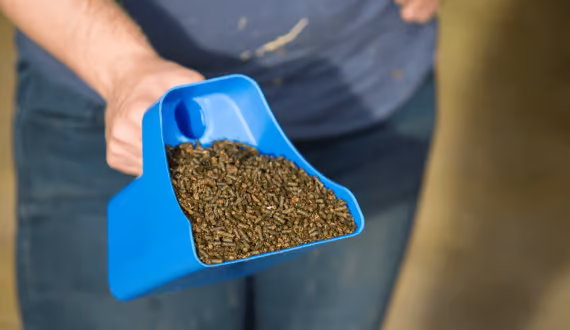
Together, the two companies developed pellets with a slower sinking speed, allowing the fish more time to eat.

NORWAY – Norwegian salmon producer Andfjord Salmon has teamed up with global aquafeed leader Skretting to develop a specialised salmon feed tailored to its unique closed aquaculture system (CAS) on the remote island of Andøya, deep in Norway’s Arctic archipelago.
Driven by a bold vision to create the world’s most sustainable land-based aquaculture facility, Andfjord Salmon has designed a low-energy, shore-based system that uses laminar water flow and minimal current to replicate optimal ocean conditions for Atlantic salmon.
But such innovation comes with unique challenges, especially when it comes to feeding the fish.
“When we started feeding our first batch of fish, we weren’t getting the appetite we wanted,” explained Christian Halmøy Torgersen, Chief Operating Officer at Andfjord Salmon.
“Because we have a low flow of water through the pool, the feed pellets were falling straight down. With a depth of only 15-16 meters, the fish couldn’t catch the feed before it sank to the bottom.”
Rather than opting for an off-the-shelf solution, Andfjord partnered closely with Skretting to create a feed engineered explicitly for their CAS environment.
“We found Skretting to be more than a feed supplier – they are a feed collaborator,” Christian noted.
Together, the two companies developed pellets with a slower sinking speed, allowing the fish more time to eat. The result was immediate: “We were able to increase feeding by 60% in only three days,” he said.
Additionally, the feed included a recirculation component, a faeces binder that improved water stability and waste collection, leading to better water quality and more efficient sludge removal.
This helped reduce turbidity and aligned with Andfjord’s commitment to environmental sustainability.
The slower-sinking feed also had a positive impact on fish health and growth. Smaller fish had better access to feed, reducing weight variation and enhancing performance.
“When we introduce health feeds, like skin care feed, more fish are able to access it. I think this is one of the reasons we had no wounds during the whole winter,” Christian added.
Impressive first-cycle results
Andfjord’s first production cycle has yielded impressive results: a 97.5% survival rate, a feed conversion ratio (FCR) of 1.05, and just 1 kWh of energy used per kilogram of salmon produced.
“Our mission to do fish farming with a clear conscience and sustainably is a good match with the way Skretting thinks about not just producing feed but doing it sustainably,” Christian said.
As the collaboration matured, the companies explored more novel and sustainable feed ingredients. Instead of fish oil, Andfjord opted for algae oil to boost omega-3 content and tested Calanus, a locally available zooplankton species and natural prey of salmon, as an alternative protein source.
“We used it as an alternative protein source and an attractant, and it worked tremendously well,” Christian said.
Next growth phase
Andfjord is currently undergoing a major expansion, with new pools scheduled to receive smolt in late 2025.
Skretting remains closely involved, supporting feed strategies and exploring innovations such as light regimes, new hydrodynamic designs, and advanced feed distribution technologies.
Truls Dahl, commercial director for CAS at Skretting Norway, emphasised the value of early collaboration: “Our close relationship with Andfjord is a great example of customer intimacy. By joining them so early on in their journey, we became deeply acquainted with their issues, which allowed us to craft effective solutions together.”
Sign up HERE to receive our email newsletters with the latest news updates and insights from Africa and the World, and follow us on our WhatsApp channel for updates.

Be the first to leave a comment