

FAO distributes livestock feed to 3,200 vulnerable Sudanese households
FAO has distributed 100 tonnes of concentrated feed to 3,200 Sudanese households to support livestock during drought-driven feed shortages.
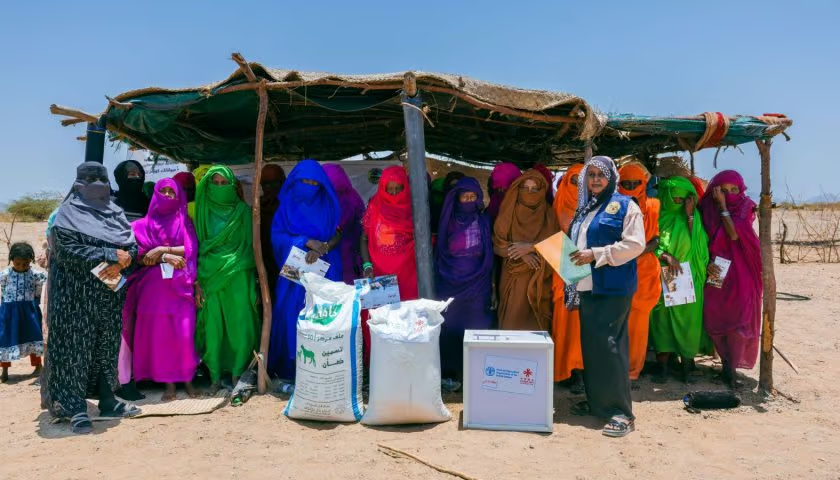
SUDAN – FAO has distributed concentrated animal feed to 3,200 vulnerable agropastoral households in Sudan’s Red Sea State to protect livestock health and maintain milk production amid severe feed shortages caused by drought and prolonged dry conditions.
The intervention is supporting households in Suakin locality, where poor rainfall has degraded natural pastures and reduced agricultural production, leaving limited crop residues available for livestock feed.
Each household received 100 kg of concentrated feed, enough to support four lactating goats for approximately two months during the dry season.
FAO said the support is intended to maintain milk production until winter rains arrive in October.
The distribution forms part of a wider livestock and livelihood support programme targeting 5,000 registered vulnerable households in the locality.
On 7 June, 157 households in Handoub village received feed, including 82 female-headed households.
The feed support comes as Sudan faces a severe food security crisis, with 19.5 million people experiencing severe acute food insecurity, according to the project information.
For agropastoral households, livestock are a key household asset and provide milk, income, and breeding stock.

Deteriorating pasture conditions have therefore increased pressure on both livestock health and household livelihoods.
“This year was extremely dry. The grazing land has almost disappeared, and we could not find feed for our sheep,” said Alawiya Jaafar, a mother of four from Handoub village.
Jaafar’s household received two 50 kg bags of concentrated feed. She said the support has enabled the family to retain milk for household consumption while selling surplus milk in local markets.
Feed and animal health support
FAO and Sudan’s local Animal Resources Directorate also provided training on supplementary feeding, hay-making and livestock husbandry.
Communities received guidance on feed mixing and feeding frequency to improve the use of available feed resources.
The intervention has also included veterinary services, including vaccination, treatment and deworming, with particular attention to livestock owned by female-headed households and people with disabilities.
Improved livestock health and reproductive performance can help households rebuild their herds through new births, with animals either sold to generate income or retained for breeding and milk production.
The wider project is supported by US$2 million in emergency assistance from the Government of China through the China Global Development and South-South Cooperation Fund.
Beyond livestock, the programme covers agriculture, fisheries and water resources, including seed and agricultural input distribution, fishing equipment, water-harvesting rehabilitation and technical training.
In Red Sea State, the livestock component is helping vulnerable households maintain animal production during feed shortages while strengthening their capacity to manage future climate and economic shocks.
Sign up HERE to receive our email newsletters with the latest news updates and insights from Africa and the World, and follow us on our WhatsApp channel for updates.
Be the first to leave a comment