

Europe’s feed sector warns of growing reliance on imported vitamins and amino acids
Production in the EU has struggled to keep pace with China, where lower energy and raw material costs have encouraged investment and large-scale output.
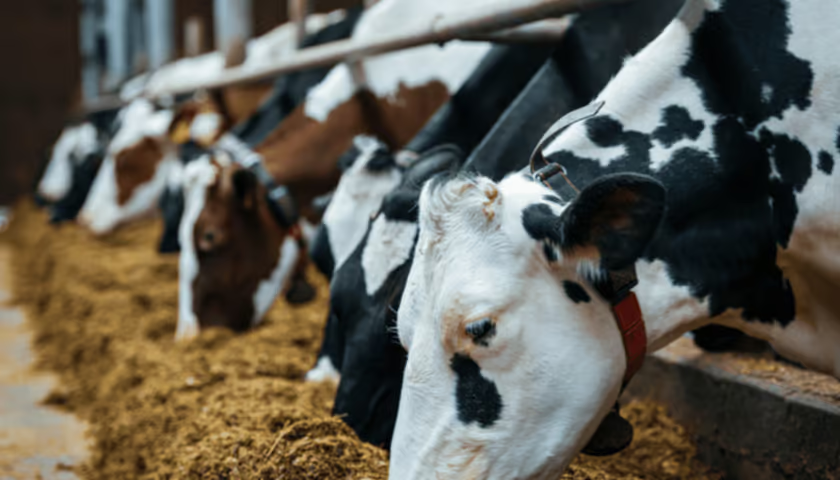
EUROPE – Europe’s livestock and aquaculture sectors face growing supply risks as the region remains overwhelmingly dependent on imports of vital vitamins and amino acids needed for animal feed, according to a new analysis by the European Feed Manufacturers’ Federation (FEFAC).
The Brussels-based industry body says its latest assessment of nutrient supply chains shows that the European Union (EU) relies heavily on a small number of non-EU producers, leaving animal production vulnerable to disruptions that could undermine animal health, productivity and long-term food security.
In response, FEFAC is renewing its call for a strong EU industrial strategy to rebuild domestic manufacturing capacity for these critical feed ingredients.
For decades, Europe’s ability to manufacture vitamins and amino acids has been limited, but FEFAC warns that competitiveness has declined further in recent years.
Production in the EU has struggled to keep pace with China, where lower energy and raw material costs have encouraged investment and large-scale output.
As a result, there has been little recent investment in vitamin and amino acid production within the EU.
At the same time, global demand for these micronutrients is increasing. Growth in animal production worldwide is one factor, while tighter environmental regulations are another.
Measures to reduce nitrogen emissions, for example, have encouraged more precise feed formulations that rely on targeted amino acid supplementation rather than higher overall protein levels.

FEFAC’s analysis highlights the fragility of global supply chains, noting that for some vitamins, only a handful of manufacturers exist worldwide, often concentrated in just two or three countries.
Any incident affecting production could quickly trigger shortages. With limited stockholding capacity, the EU could face serious supply challenges at short notice.
“A shortage of a vitamin or amino acid could compromise animal health, reduce performance and reproduction, and over the longer term jeopardize European production of meat, milk, eggs and fish,” FEFAC warns.
Why vitamins and amino acids matter
Vitamins play an essential role in animal growth, development and reproduction, and deficiencies can have severe impacts on health and productivity. Because animals generally cannot synthesize vitamins themselves, they depend on feed to meet their needs.
When natural feed ingredients fall short, manufacturers add precisely formulated vitamin premixes.
Amino acids, meanwhile, are the building blocks of protein and are equally critical for growth and for the production of meat, milk and eggs. Several amino acids are classified as “essential,” meaning animals cannot produce them on their own.
Modern feeding strategies now rely on supplementing specific amino acids rather than increasing total dietary protein, a shift that reduces nitrogen excretion and environmental impact.
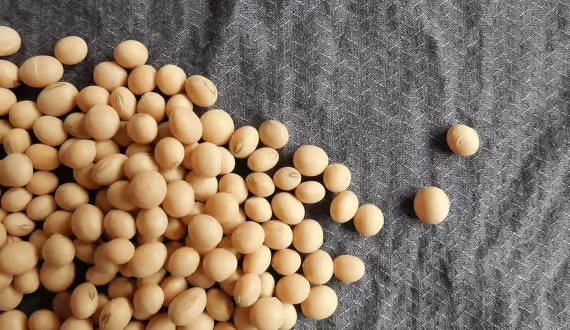
According to FEFAC, this targeted approach also cuts demand for protein-rich raw materials such as soy, reducing EU imports of soybean meal by as much as 3 million metric tons annually.
Heavy reliance on a narrow supplier base
The report underlines just how concentrated global vitamin production has become. China accounts for around 80% of total world vitamin output, while only about 8% is produced within the EU.
Several vitamins are not manufactured in the bloc at all, including vitamins B9 (folic acid), C and K3, as well as the amino acid threonine. The EU depends entirely on China for folic acid, alongside 96% of its biotin and 94% of its lysine.
Overall, EU member states import between 35% and 100% of their vitamin requirements for animal feed, with 60–70% originating from China. FEFAC adds that reliance may be even higher once dependence on non-EU suppliers of key vitamin precursors is taken into account.
Despite these risks, FEFAC’s latest forecast suggests EU compound feed production will edge slightly higher year on year in 2025, reinforcing the urgency of securing resilient, sustainable nutrient supply chains within Europe.
Sign up HERE to receive our email newsletters with the latest news updates and insights from Africa and the World, and follow us on our WhatsApp channel for updates.
Be the first to leave a comment