

UK supermarkets face potential risks over chicken feed linked to deforested land
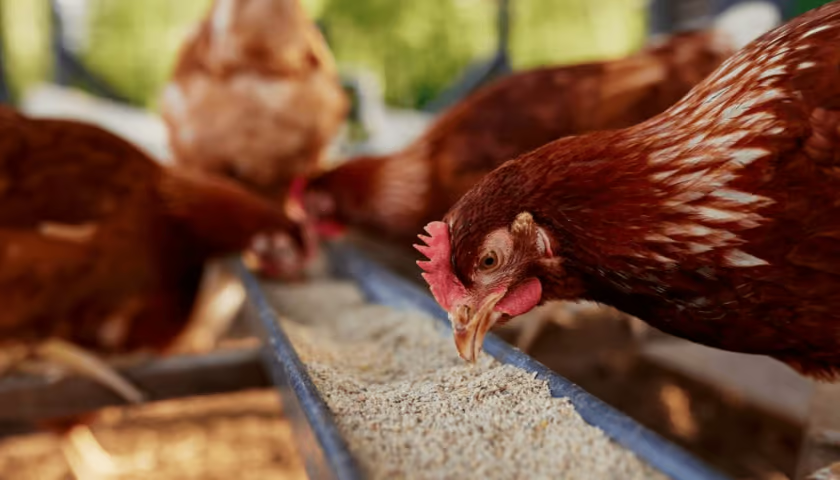
UK – A recent environmental nonprofit Mighty Earth investigation has raised concerns that UK supermarkets and fast-food chains could be at risk of violating upcoming anti-deforestation laws by selling chicken products linked to deforested land.
The report highlights connections between Moy Park, a leading UK poultry supplier, and Cargill, a US-based soy supplier allegedly linked to deforestation in Brazil.
Moy Park supplies approximately 30% of the UK’s poultry market, making it a significant supplier to major supermarkets, including Tesco, Asda, Sainsbury’s, and Waitrose, as well as to fast-food giants such as KFC and McDonald’s.
In sourcing chicken fed on soy linked to deforested regions, these companies could unknowingly breach new regulations designed to curb the import of products contributing to illegal deforestation.
The regulations, part of the UK’s Environment Act 2021, will require companies to avoid commodities from illegally deforested areas and be transparent about their supply chains.
Cargill, responsible for the majority of soy imported to the UK, has faced ongoing scrutiny for its operations in Brazil’s Cerrado region—a vast savannah increasingly affected by deforestation.

Mighty Earth alleges that Cargill’s supply chain includes soy from recently deforested lands in Brazil.
According to the report, around 11,827 hectares of forest were lost to soy farming from 2022 to 2023, with 2.4 million hectares further destroyed in fires in August 2024, much of it in Cerrado.
The UK imports over 3 million tonnes of soy annually, primarily for animal feed, with about 70% coming from high-risk deforestation countries like Brazil, Argentina, and Paraguay.
Although Cargill has disputed Mighty Earth’s findings, maintaining that it does not source from some of the farms identified in the report, the issue underscores challenges in ensuring transparency.
Cargill employs a “mass balance” system, blending soy from various sources, making it difficult to trace soy back to individual farms.
According to Mighty Earth, this opacity leaves retailers unable to verify that their products are free of links to deforestation.
The UK government’s Forest Risk Commodities regulation aims to prevent imports from illegally deforested areas, but environmental advocates argue that the law should go further.
While the UK currently defers to local laws in sourcing countries to determine legality, Mighty Earth has urged the government to align more closely with the EU’s stricter Deforestation Regulation.
The EU requires precise farm-level data, including geolocation, for commodities such as soy and will ban imports linked to legal and illegal deforestation by 2026.

The UK’s law does not cover legally sanctioned deforestation, which environmentalists say constitutes a major loophole.
Supermarkets are responding cautiously. A Waitrose spokesperson supported stronger regulations and indicated that the company is investigating the report’s findings.
Meanwhile, KFC reiterated its commitment to using only deforestation-free soy by 2025.
The UK Department for Environment, Food and Rural Affairs (DEFRA) has acknowledged the importance of ensuring that UK imports do not contribute to deforestation. However, it has not yet set a timeline for secondary legislation to support the law.
Sign up to receive our email newsletters with the latest news updates and insights from Africa and the World HERE.
Be the first to leave a comment