

Nigeria expands feed production as government doubles livestock contribution
The livestock development strategy focuses on health, commercial feeds, genetics, sustainability, value chains, peacebuilding, and market expansion.

NIGERIA – President Bola Tinubu has placed commercial feed production at the centre of Nigeria’s livestock transformation strategy as the country seeks to more than double the sector’s annual economic contribution from US$32 billion to over US$64 billion, creating new opportunities for feed manufacturers, livestock producers and agribusiness investors.
Speaking at the opening of the 9th All Africa Conference on Animal Agriculture in Abuja, Tinubu said strengthening feed production would be critical to modernising Nigeria’s livestock industry, improving productivity and enhancing food security.
“Our national strategy aims to more than double the sector’s economic contributions to position Nigeria as a leading hub for livestock production and processing in Africa,” he said.
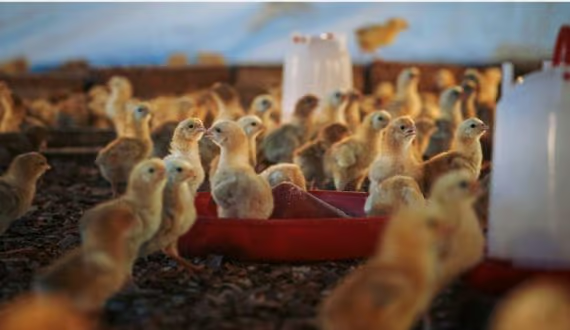
The President noted that Nigeria’s livestock population exceeds 58 million cattle, 64 million sheep, 124 million goats and 660 million poultry, creating substantial demand for high-quality commercial feed and nutrition solutions.
He said the establishment of the Federal Ministry of Livestock Development in July 2024 marked a major step towards transitioning the sector from traditional production systems to a technology-driven, commercially competitive industry.
A key pillar of the government’s National Livestock Growth Acceleration Strategy is the expansion of commercial feed production alongside improvements in animal health, livestock genetics, climate-smart farming, value-chain development and investment promotion.
Tinubu said increasing the availability of quality feed would help improve livestock productivity while supporting the development of modern ranching systems, dairy production, meat processing and export-oriented livestock businesses.
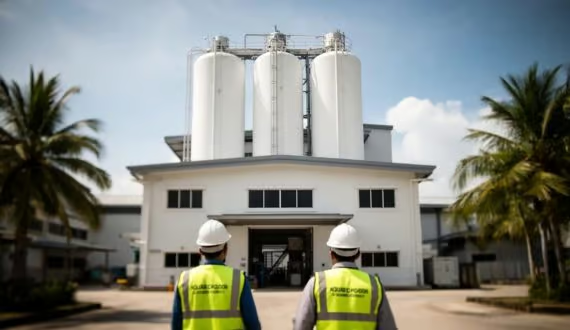
The government is also encouraging private investment in feed milling and livestock infrastructure as part of efforts to strengthen domestic supply chains and reduce production costs.

Feed industry expected to support dairy transformation
Feed production is expected to play a particularly important role in Nigeria’s dairy development programme, which aims to reduce dependence on imported dairy products by increasing local milk production.
According to Tinubu, the programme will focus on improved animal nutrition, better genetics, modern breeding systems and stronger private-sector participation.
Investments will include commercial feed production, pasture development, milk collection facilities and modern processing plants to improve the competitiveness of the domestic dairy industry.
Beyond supporting livestock productivity, the President said expanding feed manufacturing and other upstream industries would create employment opportunities for Nigeria’s growing youth population while strengthening the country’s agricultural economy.
He also called for greater regional collaboration to address shared challenges affecting Africa’s livestock sector, including animal diseases, climate change and cross-border trade, noting that innovation, science and technology would be essential to building a more resilient and productive livestock industry.
Tinubu said Nigeria remains committed to working with development partners, research institutions and private investors to strengthen livestock value chains, with feed production expected to play a central role in achieving the country’s long-term food security and agricultural growth objectives
Sign up HERE to receive our email newsletters with the latest news updates and insights from Africa and the World, and follow us on our WhatsApp channel for updates.
Be the first to leave a comment