

Asanita secures US$675K to advance feedstock development for US$22M bioethanol plant
Securing funding for strategic project components such as feedstock development is a significant step in building a resilient and sustainable ethanol value chain in Nigeria.
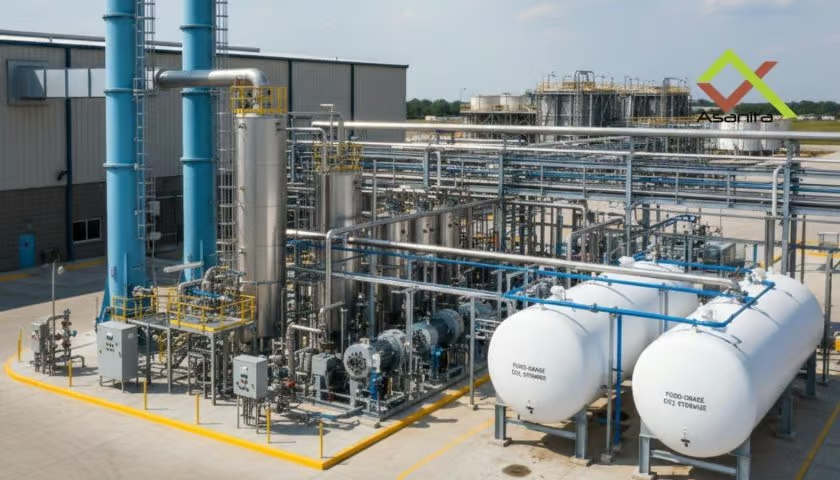
NIGERIA – Asanita Agricultural Processing Company Limited has secured US$675,000 in new funding to begin feedstock development for its planned US$22 million bioethanol plant in Edo State, marking a major step toward expanding local biofuel production and creating new markets for cassava producers.
The investment will support the establishment of a nucleus cassava farm and an outgrower scheme to supply feedstock for the proposed bioethanol facility.
This will produce high-grade ethanol for Nigeria’s pharmaceutical, cosmetics and industrial sectors, while also supporting the country’s transition to cleaner cooking fuels.
According to Manufacturing Africa, which supported the capital raise, the investment is part of efforts to strengthen Nigeria’s domestic manufacturing sector and reduce dependence on imported industrial raw materials.
Manufacturing Africa helped Asanita prepare for investment by assessing commercial opportunities across target markets, structuring the capital raise, refining the company’s investment proposition and strengthening its environmental, social and governance (ESG) credentials.
The planned integrated agricultural processing complex will include a 50,000-litre-per-day bioethanol plant, food- and medical-grade carbon dioxide production, a biomass power plant, and a nucleus cassava farm supported by an outgrower network.
Cassava has become an increasingly attractive feedstock for bioethanol production because of its high starch content.
Nigeria, the world’s largest cassava producer, harvests more than 60 million metric tonnes annually, yet only a small proportion of the crop is processed into higher-value industrial products.
By sourcing cassava locally, Asanita aims to increase demand for domestic production while reducing the country’s reliance on imported ethanol.
Manufacturing Africa estimates that around 80% of Nigeria’s ethanol demand is currently met through imports.
Project targets clean energy and rural value addition
Beyond import substitution, the project is expected to generate broader economic and environmental benefits.
The bioethanol produced will primarily serve the clean cooking market, supporting efforts to reduce reliance on traditional biomass fuels while lowering greenhouse gas emissions associated with household cooking.
The integrated facility will also adopt circular economy principles by converting agricultural waste into biomass energy, generating approximately 2.2 MW of electricity, while capturing carbon dioxide emitted during ethanol production for commercial use.
The project is also expected to strengthen rural livelihoods by creating market opportunities for cassava growers through the planned outgrower programme, providing farmers with improved market access and more stable demand for their harvests.
Manufacturing Africa, a UK-funded initiative that supports industrial investment across Africa, said the project reflects growing investor interest in climate-smart manufacturing businesses that combine commercial viability with sustainable development objectives.
Once operational, the bioethanol plant is expected to contribute to Nigeria’s renewable energy ambitions while creating value across the country’s cassava value chain through local processing, job creation and increased industrial utilisation of one of the nation’s most important agricultural crops.
Sign up HERE to receive our email newsletters with the latest news updates and insights from Africa and the World, and follow us on our WhatsApp channel for updates.


Be the first to leave a comment