

ILRI wins US$1.45M grant to strengthen AI-driven disease surveillance in Africa
The funding will advance AI-driven data analyses for genomics surveillance in low and middle-income countries
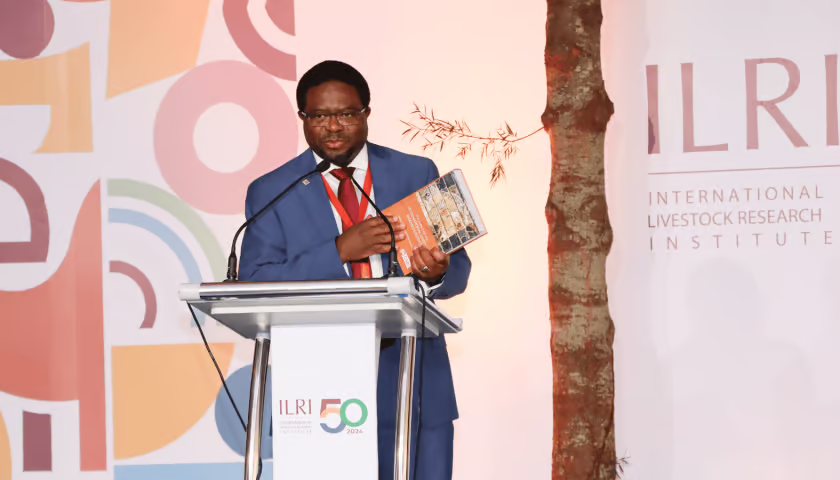
KENYA – The International Livestock Research Institute (ILRI) has secured a US$1.45 million grant from the Gates Foundation to develop artificial intelligence (AI)-powered disease surveillance systems that combine wastewater genomics, clinical data and advanced analytics to strengthen epidemic preparedness and antimicrobial resistance monitoring across Africa.
The project, led by ILRI scientist Samuel Oyola, aims to improve early detection of infectious diseases by integrating environmental genomic surveillance with clinical data, enabling faster public health responses and better-informed decision-making.
The initiative builds on ILRI’s wastewater surveillance platform, which has operated continuously across urban centres in Kenya for the past three years.
The programme analyses a large dataset generated through high-frequency wastewater sampling and shotgun metagenomic sequencing across 30 urban catchments.
Researchers will combine these environmental datasets with clinical infectious disease and antimicrobial resistance (AMR) data to develop AI-driven predictive models that can identify disease outbreaks and emerging resistance trends earlier than conventional surveillance systems.
Oyola said the project represents a significant step towards building scalable, data-driven public health systems for Africa and other low- and middle-income countries.
“This work brings together wastewater surveillance, genomics, epidemiology, artificial intelligence and public health to create practical early-warning systems capable of detecting disease threats and antimicrobial resistance in near real time,” he said.
“The vision is to transform complex genomic data into actionable public health intelligence that supports faster and more informed decision-making.”
The project aligns with global priorities on pandemic preparedness, integrated disease surveillance and antimicrobial resistance mitigation.
Expected outputs include AI-enabled predictive models, integrated environmental and clinical surveillance datasets, frameworks for incorporating wastewater epidemiology into routine surveillance systems, and policy guidance for ministries responsible for health, livestock, environment and disease surveillance.
The programme will also strengthen scientific capacity through two fully funded PhD positions and one postdoctoral fellowship based at ILRI’s Nairobi campus.
The researchers will collaborate with the University of Oxford and the Global Pathogen Analysis Platform (GPAP) at the Technical University of Denmark (DTU).
The team will also develop next-generation “agentic AI” systems capable of automating genomic analyses and generating real-time public health insights through interactive surveillance dashboards and decision-support tools.
ILRI has become a regional leader in genomic surveillance and wastewater-based epidemiology, supporting African Union member states through research, training and implementation of advanced surveillance technologies.
According to the institute, its wastewater surveillance programme has already processed thousands of samples, generating extensive pathogen and antimicrobial resistance data to support disease preparedness across the continent.
The new funding further strengthens ILRI’s role in advancing genomics, AI-enabled surveillance and One Health research linking animal, human and environmental health.
Sign up HERE to receive our email newsletters with the latest news updates and insights from Africa and the World, and follow us on our WhatsApp channel for updates.

Be the first to leave a comment