

South Africa adopts avian influenza vaccination strategy after US$529M poultry crisis
Initial findings from pilot programmes suggest that vaccination does not completely prevent infection but can significantly reduce mortality rates.
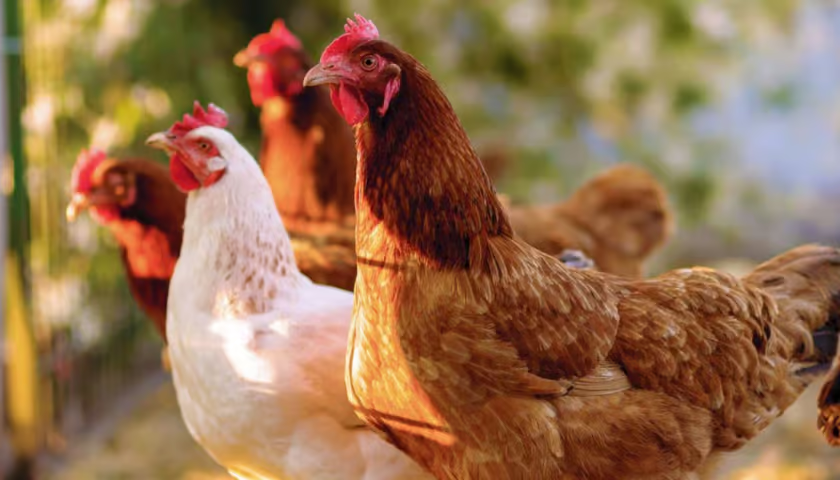
SOUTH AFRICA – South Africa has officially incorporated avian influenza vaccination into its national disease control strategy, marking a significant shift in how Africa’s largest poultry producer plans to manage future outbreaks of highly pathogenic avian influenza (HPAI).
The policy change, announced by the Department of Agriculture on June 3, moves the country away from a long-standing reliance on mass culling of infected and exposed birds and toward a hybrid disease-control model that combines vaccination, biosecurity, surveillance and laboratory testing.
The decision follows years of recurring avian influenza outbreaks that have inflicted severe losses on the poultry industry and disrupted supplies of poultry meat and eggs.
South Africa’s most devastating outbreak occurred in 2023, when the H5N1 and H7N1 strains triggered the largest avian influenza crisis in the country’s history.
Approximately 10.5 million birds, nearly one-third of the national flock, were culled to contain the disease, resulting in economic losses estimated at more than US$529 million.
The outbreak exposed vulnerabilities in the sector and intensified calls for alternative disease-control measures to reduce both mortality and economic losses.
“Our poultry farmers need concrete support, and we are changing the policy to give them a legal mechanism to protect their livelihoods,” said John Steenhuisen, South Africa’s Minister of Agriculture.
“The old regulations forced the industry to unnecessarily destroy flocks, which hurt farm businesses and increased food prices for consumers.
“By changing this policy, we are giving producers the legal right to use proven scientific tools to protect their farms, preserve farm jobs and ensure affordable food for the population.”
Pilot vaccination programmes paved the way
The decision builds on efforts launched in 2025 to evaluate the technical and economic feasibility of poultry vaccination as part of a structured disease-management programme.
Among the companies participating in early trials was Astral Foods, South Africa’s largest poultry producer, which received approval to vaccinate approximately 5% of its flock against H5 avian influenza strains.
Initial findings from pilot programmes suggest that vaccination does not completely prevent infection but can significantly reduce mortality rates, limit virus transmission and minimise production losses during outbreaks.
Industry stakeholders have increasingly viewed vaccination as a critical tool for maintaining production continuity amid recurring disease threats.
Under the new framework, vaccination will complement rather than replace existing disease-control measures.
Authorities will continue to enforce strict farm biosecurity standards, surveillance programmes and laboratory testing requirements, while maintaining oversight of outbreak investigations and response activities.
The move comes as avian influenza continues to pose challenges across Africa and globally.
Following the 2023 outbreak, South Africa reported additional outbreaks in July and September 2025, resulting in further poultry deaths and culling on commercial farms.
The country’s decision could influence disease-control strategies elsewhere on the continent as governments seek more sustainable ways to manage recurring outbreaks while safeguarding food security and the growth of the poultry sector.
In West Africa, for example, Côte d’Ivoire reported an avian influenza outbreak earlier this year after five years without a major occurrence, highlighting the continuing threat posed by the disease across the region.
As outbreaks become more frequent, South Africa’s transition to a vaccination-based approach may offer a new model for balancing animal health protection, industry sustainability and food supply stability across Africa’s poultry sector.
Sign up HERE to receive our email newsletters with the latest news updates and insights from Africa and the World, and follow us on our WhatsApp channel for updates.

Be the first to leave a comment