

South Africa boosts rural livestock health through veterinary entrepreneurship
Access to veterinary services in remote communities is often constrained by workforce shortages and shifting public sector priorities.
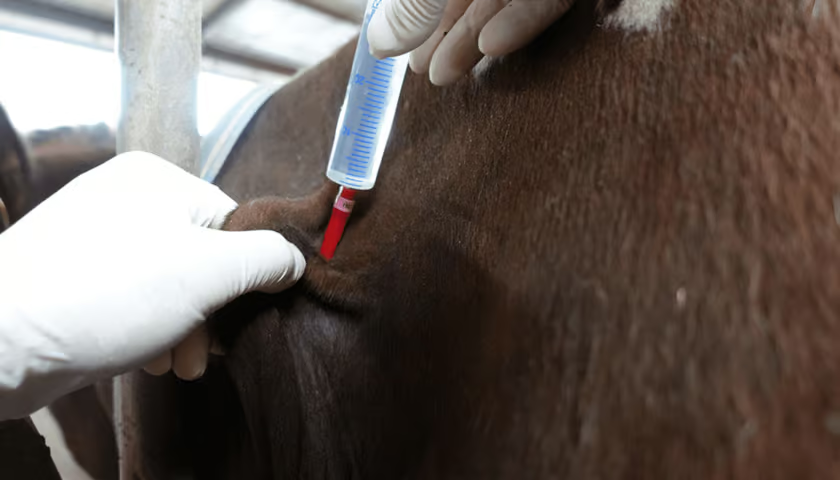
SOUTH AFRICA – The government of South Africa is expanding access to animal healthcare and strengthening rural livelihoods through a groundbreaking programme that equips veterinary paraprofessionals with both clinical and business skills.
Led by the Food and Agriculture Organization of the United Nations (FAO) in partnership with national institutions, the initiative enables Animal Health Technicians to establish Primary Animal Healthcare enterprises that improve livestock health, enhance productivity, and drive sustainable rural development.
The programme, showcased at the 19th FAO Subregional Multi-Disciplinary Team (MDT) Meeting for Southern Africa, demonstrates how innovative training and entrepreneurship can fill critical gaps in veterinary service delivery while supporting inclusive agrifood systems.
Livestock remains a cornerstone of rural livelihoods in South Africa, providing food, income, and social security for smallholder farmers, many of whom are women.
Yet access to veterinary services in remote communities is often constrained by workforce shortages and shifting public sector priorities.
Veterinary paraprofessionals (VPPs), such as Animal Health Technicians, are well-positioned to bridge this gap but face obstacles including limited business training, regulatory barriers, and lack of mentorship.
To address these challenges, FAO collaborated with the Department of Agriculture, the South African Veterinary Council, and local training institutions to empower unemployed Animal Health Technicians with entrepreneurial and clinical competencies to establish private practices.
“The initiative gives veterinary paraprofessionals a pathway to meaningful employment while improving livestock care in underserved areas,” an FAO representative said. “It’s about turning technical expertise into sustainable businesses that strengthen communities.”

Blended training and mentorship
Implemented in partnership with the Tsolo Agriculture and Rural Development Institute and North-West University, the programme used a blended learning model combining online coursework, in-person workshops, field placements, and ongoing mentorship.
Participants engaged in community consultations and focus group discussions to tailor their services to local needs.
Through public–private engagement platforms, Animal Health Technicians connected with veterinarians, producer groups, and agribusinesses to ensure regulatory alignment, market access, and service quality. This multi-stakeholder model strengthened professional recognition and improved coordination across the animal health value chain.
Since its inception, the initiative has trained 110 veterinary paraprofessionals, over 70 percent of them women, directly supporting around 1,100 smallholder farmers.
Fourteen new Primary Animal Healthcare businesses have already been established, delivering preventive services such as disease monitoring, vaccination, and early detection in rural communities.
Graduates are now working closely with government veterinary services, enhancing disease surveillance and promoting animal welfare.
“This project has shown that empowering women and youth in veterinary entrepreneurship can transform rural economies,” the FAO noted.
Building for sustainability and One Health integration
To ensure long-term impact, FAO and its partners are developing training-of-trainers systems and open-access learning materials that national institutions can use to sustain future training cohorts.
The next phase will focus on securing financial services for start-ups, embedding the model in veterinary education, and aligning policy and regulatory frameworks.
By fostering local veterinary entrepreneurship, South Africa is not only improving animal health but also advancing its One Health goals, linking human, animal, and environmental wellbeing.
With continued investment and policy support, the model could be scaled up across Southern Africa, creating more inclusive and resilient livestock systems.
Sign up HERE to receive our email newsletters with the latest news updates and insights from Africa and the World, and follow us on our WhatsApp channel for updates.


Be the first to leave a comment