
Morocco launches US$674M livestock recovery plan amid severe drought losses
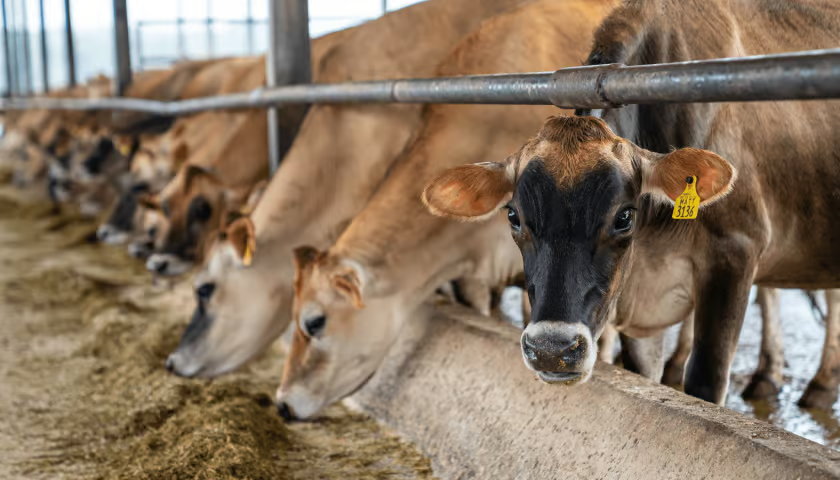
Years of below-average rainfall have devastated pasturelands across the country, forcing farmers to rely on increasingly expensive feed alternatives.
MOROCCO – The Moroccan government has unveiled a US$674.4 million recovery initiative aimed at rebuilding the nation’s sheep population and restoring stability to rural livelihoods, in a move to rescue its drought-stricken livestock sector.
The plan, announced by Agriculture Minister Ahmed Bouari on May 22, will run from 2025 to 2026 and focuses on five core components: cancelling debts for 50,000 herders, subsidising livestock feed, preserving female sheep for breeding, launching a nationwide vaccination campaign, and providing technical support to livestock keepers.
“This is a response to the unprecedented losses our livestock sector has suffered due to persistent drought,” said Bouari during the announcement. “We are committed to protecting the livelihoods of Moroccan herders and ensuring food security for our people.”
Years of below-average rainfall have devastated pasturelands across the country, forcing farmers to rely on increasingly expensive feed alternatives.
These costs have contributed to a 38% decline in Morocco’s cattle and sheep population since 2016, according to a 2025 livestock census by the Ministry of Agriculture.
Slaughter ban on female sheep and goats
To slow the decline, the government took several emergency measures earlier this year. On March 19, it imposed a nationwide ban on the slaughter of female sheep and goats, a rule that will remain in place until March 2026.
The restriction, detailed in a joint circular from the Ministry of the Interior and the Ministry of Agriculture, is designed to protect breeding stock and stabilise herd numbers.
Further highlighting the crisis, the government suspended the traditional Eid al-Adha sacrifice for 2025.
The annual practice typically results in the slaughter of five to eight million sheep and goats, a level that officials now deem unsustainable. King Mohammed VI has called on Moroccans to support the suspension, framing it as a patriotic act of conservation.
“This is not an easy decision, but it is a necessary one,” said a spokesperson for the Ministry of Agriculture. “If we do not act now, the recovery of our livestock industry could be delayed by many more years.”
Increasing livestock imports
To bridge the gap between supply and demand, Morocco has ramped up livestock imports. Trade Map data shows that the country’s spending on imported sheep and goats more than doubled in a year, rising from US$62.7 million in 2023 to nearly US$149.3 million in 2024.
As part of the 2025 budget, authorities have authorised the import of 720,000 animals to support local supply chains.
But while imports may provide short-term relief, experts warn that the sector’s long-term recovery hinges on adaptation.

Climate change is expected to exacerbate water scarcity in North Africa, posing ongoing challenges for traditional livestock practices.
“The success of this program won’t just depend on money—it depends on how well herders can adapt,” said a senior official in the Ministry of Agriculture. “Supporting them through technical training and climate-resilient strategies is just as crucial as financial aid.”
For now, the government’s priority is to safeguard existing herds, reduce the pressure on overgrazed land, and help farmers stay afloat during this difficult period.
Sign up HERE to receive our email newsletters with the latest news updates and insights from Africa and the World, and follow us on our WhatsApp channel for updates.


Be the first to leave a comment