

Rwanda turns cassava peels into animal feed ingredient
The initiative tackles cassava waste and high animal feed costs.
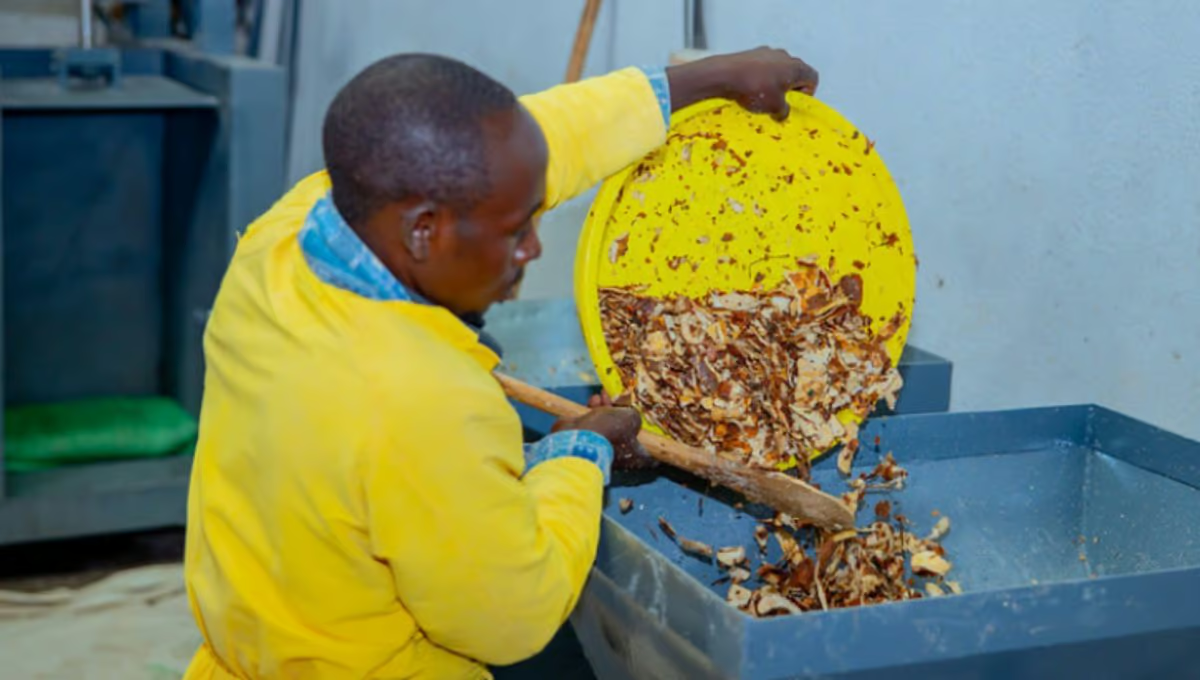
RWANDA – Kabizu Business Group has turned cassava processing waste into High-Quality Cassava Peels (HQCP), creating a locally produced animal feed ingredient while reducing waste from cassava processing.
The agro-processing company, based in Rwanda, developed its HQCP production facility with technical support from the International Institute of Tropical Agriculture (IITA) Rwanda through the Rural-Urban Nexus (RUNRES) project.
The initiative aims to address two challenges facing the livestock sector: the disposal of large volumes of cassava peels and the high cost of conventional animal feed ingredients.
Processed HQCP can provide livestock producers with a source of fermentable carbohydrates for feed.
“Cassava peels are rich in fermentable carbohydrates, but in their raw form, they carry anti-nutritional compounds and moisture levels that make them unsafe and unstable as feed,” said Emmanuel Rukundo, research associate at IITA Rwanda.
He said the processing protocols introduced through RUNRES reduce cyanogenic compounds to safe levels while stabilising the product for storage and transport.
Kabizu Business Group founder and managing director Bizumuremyi Christian said the company initially faced difficulties convincing stakeholders that cassava peels could become a commercial feed ingredient.
“Our biggest challenge was convincing people that cassava peels are not waste but a valuable resource. We also faced limited processing technology, financial constraints, and the challenge of meeting strict quality standards,” Christian said.
From waste to feed
The processing facility uses grating and drying systems to convert freshly processed cassava peels into HQCP.
The resulting product is being used as an animal feed ingredient, including in pig and poultry production.
Rukundo said consistent quality is critical if cassava peels are to become a reliable feed input.
“It’s not enough to have an idea. You need consistent quality control, proper drying and grating systems, and a feed product that livestock producers can trust batch after batch,” he said.
The initiative has also created employment opportunities and additional markets for cassava farmers, while giving processors an additional revenue stream from a material that would otherwise be discarded.
Christian said the project had changed his approach to business and demonstrated the potential for agricultural waste to generate both economic and environmental value.

“The project has completely changed my perspective as an entrepreneur. It has given me the confidence to invest in innovation and sustainability,” he said.
Kabizu Business Group plans to expand HQCP production to supply feed manufacturers across Rwanda and neighbouring countries.
The company also intends to develop additional value-added products from cassava processing residues as it works towards a more integrated, zero-waste processing model.
The initiative highlights the potential for locally available agricultural by-products to become alternative feed ingredients, while creating additional value across the livestock and cassava value chains.
Sign up HERE to receive our email newsletters with the latest news updates and insights from Africa and the World, and follow us on our WhatsApp channel for updates.


Be the first to leave a comment