

Study warns feed shortage may limit aquaculture growth
Researchers urge investment in alternative ingredients such as microbial, algal, insect-based, and next-generation plant proteins.
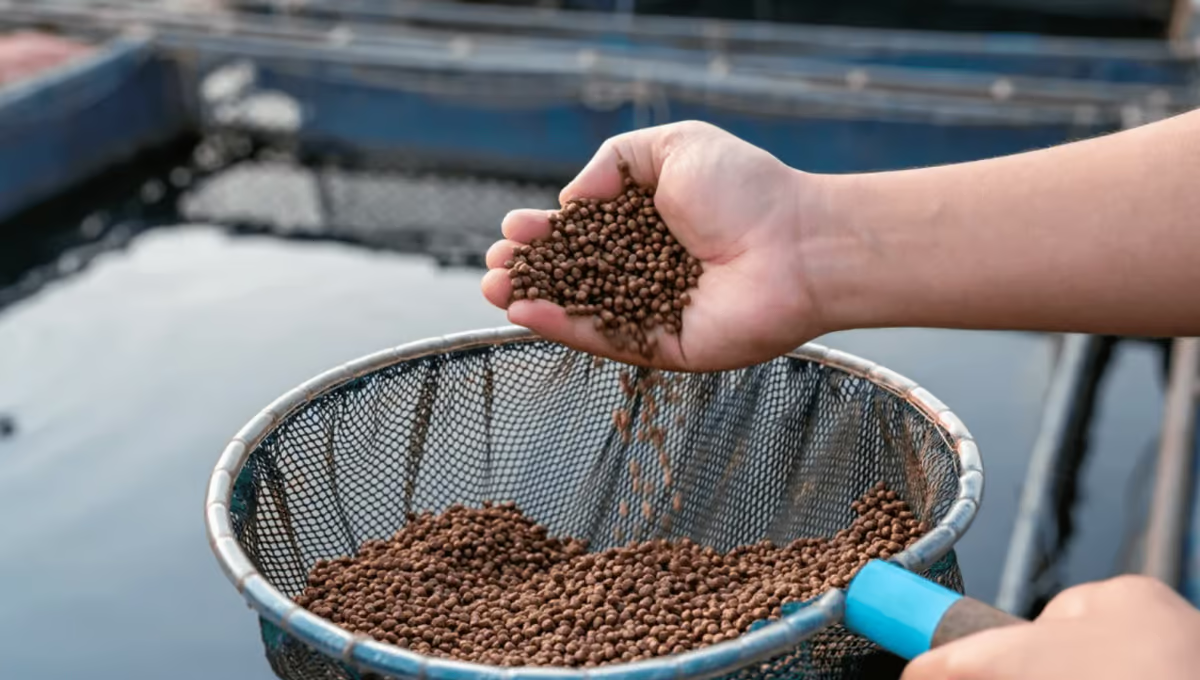
GLOBAL – A new study by researchers affiliated with the F3 – Future of Fish Feed initiative has warned that a looming shortage of feed ingredients could curtail aquaculture’s future growth, unless the industry rapidly scales up alternative proteins and novel feed sources.
The findings, published in Nature Food, highlight how aquaculture’s expansion remains tied to the very ocean resources it aims to conserve.
The research was conducted by scientists from Xiamen University, the University of Massachusetts Boston, the University of Arizona, and the University of Tasmania.
They found that despite improved efficiency in using fishmeal and fish oil, aquaculture will still require an additional 1.8 million metric tons of alternative feed ingredients each year to meet the rising global demand for high-value farmed seafood such as salmon and shrimp.
“This is a practical moment to secure feed supply and unlock new value streams,” said lead author Professor Ling Cao of Xiamen University and a judge of the F3 Challenge.
“Treating fishmeal and fish oil as strategic, finite resources, while accelerating alternative innovations, can help sustain aquaculture growth and reduce exposure to supply variability.”

A sector at a crossroads
Aquaculture is now the fastest-growing food production sector in the world, supplying more than half of global seafood and nearly one-fifth of all animal-sourced protein.
As the global population approaches 10 billion by mid-century, its continued expansion is viewed as vital for food security.
In a landmark moment, global aquaculture production surpassed wild-capture fisheries for the first time in 2022, underscoring its central role in feeding the world.
However, the study cautions that the sector’s dependence on finite marine resources poses a major vulnerability.
The researchers developed a novel shortfall impact model to examine how changes in forage fish supply, driven by climate change and fishery management restrictions, might affect global fed aquaculture.
Their model predicts that a 20 percent reduction in forage fish catches could trigger a 35 percent drop in global aquaculture output, with declines of over 70 percent for certain high-value species if alternative feed ingredients are not expanded.
“Aquaculture has already made big strides in squeezing more value out of every kilogram of fishmeal and oil use,” said Professor Kevin Fitzsimmons of the University of Arizona, another co-author and F3 Challenge judge.
“Continued progress will come from expanding supply options and advancing technologies in feed formulation and circular resources use.”

The race for feed innovation
The study’s authors argue that the industry must urgently diversify its feed base. Fishmeal and fish oil, they warn, should be treated as strategic but finite commodities whose prices and availability are increasingly volatile.
To mitigate these risks, the researchers urge investment in alternative ingredients such as microbial, algal, insect-based, and next-generation plant proteins, alongside improvements in breeding, feed formulation, and waste circularity.
Recent disruptions illustrate the stakes. The 2023 closure of Peru’s anchoveta fishery, one of the world’s largest, caused significant turmoil in fish oil markets, constraining aquaculture production.
Though algae-based oils helped fill part of the supply gap, the incident highlighted how vulnerable global feed systems remain to fluctuations in marine resources.
As demand for sustainable “blue foods” continues to surge, the study concludes that scaling alternative feeds is not just an environmental necessity but a strategic imperative.
Without swift innovation, the global aquaculture industry may find itself caught between booming demand and a tightening feed bottleneck.
Sign up HERE to receive our email newsletters with the latest news updates and insights from Africa and the World, and follow us on our WhatsApp channel for updates.


Be the first to leave a comment